


Basics Of Tolerance Stack-Up Analysis And Fits With Gd&t
Category: Tutorials
- views: 286
- date: 10 June 2026
- posted by: 0nelove
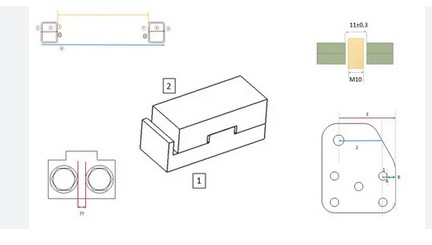
Basics Of Tolerance Stack-Up Analysis And Fits With Gd&t
Last updated 12/2025
Created by Mufaddal Rasheed
MP4 | Video: h264, 1920x1080 | Audio: AAC, 44.1 KHz, 2 Ch
Level: All Levels | Genre: eLearning | Language: English + subtitle | Duration: 61 Lectures ( 4h 27m ) | Size: 996.4 MB
Learn About Tolerances Stack-up Analysis and about fits in engineering with multiple examples with GD&T for mechanical
What you'll learn
⚡ The Basics of Limits and Fits
⚡ How to do a simple Tolerance stackup analysis
⚡ How to do a Tolerance stackup analysis with GD&T
⚡ What is statistical tolerancing
⚡ How to Perform 1 D Tolerance stack up analysis
Requirements
❗ Basic understanding of engineering design
❗ One section requires understanding of Basics of GD&T - Concepts like Virtual condition , boudnaries, Material modifiers, Datum Shift
Description
Understanding Tolerances and tolerancing schemes is a very important part of Mechanical design .
In most cases Tolerances are directly detrimental to the functional performance of a mechanical product.
This course attempts to cover the key concepts in tolerance stackup , limits, fits and statistical tolerancing with examples .
Tolerance stackup analyses are critical in applications where small changes in dimension of parts can have heavy consequences.
What we will cover in the course?
✨ What is tolerance? What are sources of variation ?
✨ What are Fits , the nomenclature, types and Tolerance zones
✨ How to decode and interpret a Fit specification and convert it into limits
✨ How to Define a specification of a Fit for a specific application
✨ How to do a simple tolerance stackup ? Generic procedure and factors to be considered?
✨ How to develop Loop Diagrams in Stackup ?
✨ Assembly shift in Tolerance analysis
✨ How is assembly shift calculated
✨ Stackup with GD&T
✨ How to find Boundary conditions accounting for size and positional variations
✨ How to derive the individual specifications in tolerance table
✨ How to develop the envelopes for GD&T controls
✨ Statistical Tolerancing
✨ Why Statistical techniques are used?
✨ What is normal distribution
✨ What is difference between worst case and statistical analysis
✨ What is Process capability index
The course is structured to provide learning in a methodical step by step way with clear explanations .
Core Learning outcome is to provide a strong foundation concept in Tolerance analyses for mechanical Engineers in design and manufacturing.
Who this course is for
⭐ Graduate students in Engineering
⭐ Working Design professionals in Engineering industry
Homepage
https://anonymz.com/?
https://www.udemy.com/course/basics-of-tolerance-analyses-stackup-and-fits
https://rapidgator.net/file/c6ee7eb013b28f1bed25ff9906f13ef6/Basics_of_Tolerance_Stack-up_Analysis_and_Fits_with_GD&T.part2.rar.html
https://rapidgator.net/file/7b10ef92b0f7bc25588203fe59cad856/Basics_of_Tolerance_Stack-up_Analysis_and_Fits_with_GD&T.part1.rar.html
https://nitroflare.com/view/7DE325B43AB53CC/Basics_of_Tolerance_Stack-up_Analysis_and_Fits_with_GD%26amp%3BT.part2.rar
https://nitroflare.com/view/6A72ADAF5B1630A/Basics_of_Tolerance_Stack-up_Analysis_and_Fits_with_GD%26amp%3BT.part1.rar
We need your support!
Make a donation to help us stay online

Bitcoin (BTC)
bc1q08g9d22cxkawsjlf8etuek2pc9n2a3hs4cdrld

Bitcoin Cash (BCH)
qqvwexzhvgauxq2apgc4j0ewvcak6hh6lsnzmvtkem

Ethereum (ETH)
0xb55513D2c91A6e3c497621644ec99e206CDaf239

Litecoin (LTC)
ltc1qt6g2trfv9tjs4qj68sqc4uf0ukvc9jpnsyt59u

USDT (ERC20)
0xb55513D2c91A6e3c497621644ec99e206CDaf239

USDT (TRC20)
TYdPNrz7v1P9riWBWZ317oBgJueheGjATm
Information |
|||
 |
Users of GUESTS are not allowed to comment this publication. | ||