


Carbon Accounting: Ghg Emissions Calculation – Scope 1 & 2
Category: Tutorials
- views: 124
- date: 10 May 2026
- posted by: 0nelove
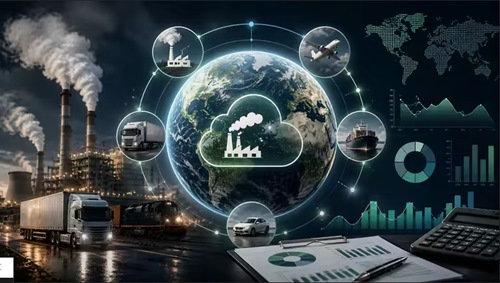
Carbon Accounting: Ghg Emissions Calculation – Scope 1 & 2
Published 5/2026
MP4 | Video: h264, 1920x1080 | Audio: AAC, 44.1 KHz, 2 Ch
Language: English | Duration: 5h 40m | Size: 3.1 GB
Learn to calculate Scope 1 and 2 GHG emissons inline with GHG Protocol for disclosures required under ESRS E1, IFRS S2
What you'll learn
Understand climate change fundamentals and the role of greenhouse gas emissions
Explain and apply GHG accounting principles and carbon accounting frameworks
Use the GHG Protocol for building emissions inventories
Accurately calculate Scope 1 and Scope 2 emissions
Convert real-world activity data into carbon footprint calculations
Understand how emissions data supports net zero targets and decarbonization strategies
Requirements
No perior experience required
Description
If you're looking to build practical, job-ready skills in GHG accounting, carbon accounting, and ESG reporting, this course will take you from foundational concepts to real-world application.
Greenhouse Gas (GHG) emissions sit at the center of climate change, sustainability reporting, and net zero strategies. Today, organizations across industries are expected to measure, manage, and disclose their carbon footprint using globally accepted frameworks such as the GHG Protocol. However, most learners struggle to move beyond theory and actually understand how emissions are calculated in practice — and that's exactly where this course stands out.
In this course, you will learn how to calculate emissions across Scope 1, Scope 2, and Scope 3, using realistic business scenarios and structured methodologies. We go beyond definitions and focus on how companies perform carbon accounting in real-world environments — from identifying emission sources and collecting activity data to applying emission factors and preparing accurate, audit-ready outputs.
You'll gain hands-on exposure to emission calculation techniques, including fuel combustion, electricity consumption, and value chain emissions. The course also helps you understand critical concepts like emission factors, global warming potential (GWP), data quality checks, and reporting frameworks used in ESG disclosures.
By the end of this course, you will have a strong understanding of how GHG inventories are developed, validated, and used for sustainability reporting, regulatory disclosures, and decarbonization strategies.
Whether you're aiming to build a career in sustainability, transition into ESG roles, or strengthen your understanding of carbon accounting and climate reporting, this course provides a clear, practical, and industry-relevant foundation.
Who this course is for
Students and graduates interested in sustainability, climate change, ESG, or carbon accounting careers
Professionals working in ESG reporting, sustainability, finance, consulting, or corporate strategy
Analysts involved in data, reporting, compliance, or environmental metrics
Anyone looking to understand Scope 1, and Scope 2 emissions in a practical way
https://rapidgator.net/file/37c545d9200501afceaf2d6c21271224/Carbon_Accounting_GHG_Emissions_Calculation_Scope_1_&_2.part4.rar.html
https://rapidgator.net/file/4baedcf1985e9006b18e88ef340f0918/Carbon_Accounting_GHG_Emissions_Calculation_Scope_1_&_2.part3.rar.html
https://rapidgator.net/file/07ea762e96250c48b10f4db4b6404076/Carbon_Accounting_GHG_Emissions_Calculation_Scope_1_&_2.part2.rar.html
https://rapidgator.net/file/38217dbc919261417f570218f9f446b1/Carbon_Accounting_GHG_Emissions_Calculation_Scope_1_&_2.part1.rar.html
https://nitroflare.com/view/5768975317B0DE1/Carbon_Accounting_GHG_Emissions_Calculation_Scope_1_%26amp%3B_2.part4.rar
https://nitroflare.com/view/8923C9E1C1B11B7/Carbon_Accounting_GHG_Emissions_Calculation_Scope_1_%26amp%3B_2.part3.rar
https://nitroflare.com/view/0FAFC4E900BD96A/Carbon_Accounting_GHG_Emissions_Calculation_Scope_1_%26amp%3B_2.part2.rar
https://nitroflare.com/view/2E20234FA93B825/Carbon_Accounting_GHG_Emissions_Calculation_Scope_1_%26amp%3B_2.part1.rar
We need your support!
Make a donation to help us stay online

Bitcoin (BTC)
bc1q08g9d22cxkawsjlf8etuek2pc9n2a3hs4cdrld

Bitcoin Cash (BCH)
qqvwexzhvgauxq2apgc4j0ewvcak6hh6lsnzmvtkem

Ethereum (ETH)
0xb55513D2c91A6e3c497621644ec99e206CDaf239

Litecoin (LTC)
ltc1qt6g2trfv9tjs4qj68sqc4uf0ukvc9jpnsyt59u

USDT (ERC20)
0xb55513D2c91A6e3c497621644ec99e206CDaf239

USDT (TRC20)
TYdPNrz7v1P9riWBWZ317oBgJueheGjATm
Information |
|||
 |
Users of GUESTS are not allowed to comment this publication. | ||