


Design Fluid Viscous Dampers in SAP2000 and Peform3D
Category: Tutorials
- views: 75
- date: 10 January 2026
- posted by: voska89
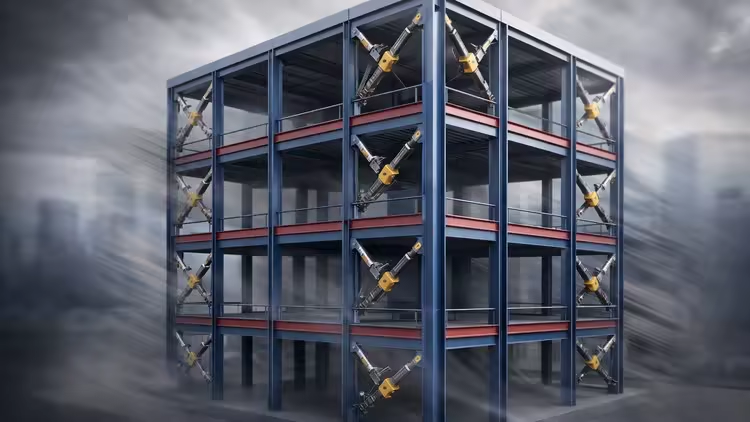
Free Download Design Fluid Viscous Dampers in SAP2000 and Peform3D
Published 1/2026
MP4 | Video: h264, 1920x1080 | Audio: AAC, 44.1 KHz, 2 Ch
Language: English | Duration: 1h 10m | Size: 964 MB
Practical seismic damper modeling, nonlinear analysis, performance-based design, and real-world applications using SAP20
What you'll learn
Understand the fundamental principles of how fluid viscous dampers improve the seismic performance of structures.
Model fluid viscous dampers step-by-step within both SAP2000 and Perform3D environments using real structural models.
Perform advanced seismic analysis to evaluate the effectiveness of damping systems in reducing structural response.
Evaluate and interpret engineering data from software outputs to ensure designs meet practical seismic safety requirements.
Requirements
Basic knowledge of structural analysis and earthquake engineering.
Access to SAP2000 and/or Perform3D software (student or professional version).
Description
Fluid Viscous Dampers (FVDs) are among the most effective passive energy dissipation devices used in modern earthquake-resistant design. This course provides a comprehensive, step-by-step guide to the modeling, analysis, and design of Fluid Viscous Dampers using SAP2000 and Perform3D, focusing on practical implementation aligned with performance-based seismic design principles.The course starts with a clear explanation of the theoretical background of fluid viscous dampers, including their mechanical behavior, force–velocity relationships, damping coefficients, and velocity exponent effects. You will gain a solid understanding of how dampers influence structural response, reduce displacements, control story drifts, and improve overall seismic performance.Next, the course moves into hands-on modeling in SAP2000, where you will learn how to define nonlinear link elements, assign damper properties correctly, and integrate FVDs into structural systems. You will perform linear and nonlinear time-history analyses, interpret key results, and evaluate damper effectiveness through displacement, acceleration, and force responses.In the advanced section, the course covers Perform3D modeling, focusing on performance-based seismic assessment, nonlinear components, damper calibration, and acceptance criteria. You will learn how to compare structural behavior with and without dampers, assess life safety and collapse prevention levels, and understand practical design decisions used in real engineering projects.This course is ideal for civil and structural engineers, graduate students, researchers, and practicing professionals who want to confidently apply seismic dampers in design offices and research studies. No prior damper experience is required—only basic knowledge of structural analysis and earthquake engineering.By the end of this course, you will be able to design, model, analyze, and evaluate fluid viscous dampers professionally using SAP2000 and Perform3D.
Who this course is for
Civil and Structural Engineers looking to specialize in seismic protection. Engineering students interested in advanced structural modeling and damping systems.
Homepage
https://www.udemy.com/course/design-fluid-viscous-dampers-in-sap2000-and-peform3d/DOWNLOAD LINK
No Password - Links are Interchangeable
We need your support!
Make a donation to help us stay online

Bitcoin (BTC)
bc1q08g9d22cxkawsjlf8etuek2pc9n2a3hs4cdrld

Bitcoin Cash (BCH)
qqvwexzhvgauxq2apgc4j0ewvcak6hh6lsnzmvtkem

Ethereum (ETH)
0xb55513D2c91A6e3c497621644ec99e206CDaf239

Litecoin (LTC)
ltc1qt6g2trfv9tjs4qj68sqc4uf0ukvc9jpnsyt59u

USDT (ERC20)
0xb55513D2c91A6e3c497621644ec99e206CDaf239

USDT (TRC20)
TYdPNrz7v1P9riWBWZ317oBgJueheGjATm
Information |
|||
 |
Users of GUESTS are not allowed to comment this publication. | ||