


Savonius Wind Turbine Cfd Analysis And Validation
Category: Tutorials
- views: 153
- date: 9 August 2025
- posted by: 0nelove
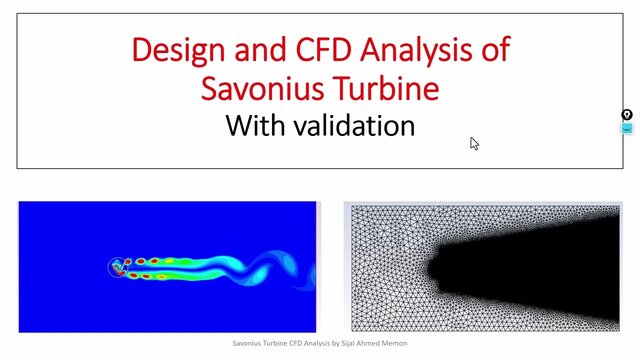
Savonius Wind Turbine Cfd Analysis And Validation
Published 8/2025
MP4 | Video: h264, 1280x720 | Audio: AAC, 44.1 KHz, 2 Ch
Language: English | Duration: 2h 10m | Size: 1.22 GB
Learn CFD from scratch by modeling, meshing, simulating, and validating Savonius wind turbines using ANSYS Fluent with r
What you'll learn
Understand the basics of wind energy and the working principle of Savonius vertical-axis wind turbines
Create accurate 2D geometry and apply high-quality meshing techniques in ANSYS, including quad elements, inflation layers, and wake region refinement
Set up transient simulations for rotating machinery using the sliding mesh approach in ANSYS Fluent
Capture aerodynamic behavior and performance of Savonius turbines under low-speed wind conditions
Validate CFD results using real experimental data from Blackwell et al. (1977), ensuring credible simulation outcomes
Requirements
A basic understanding of fluid mechanics and CFD concepts is recommended. Prior exposure to ANSYS Workbench tools like DesignModeler, Meshing, and Fluent will be helpful but is not mandatory — step-by-step guidance is provided.
Description
This course provides a complete, hands-on guide to performing 2D CFD analysis and validation of a Savonius vertical-axis wind turbine (VAWT) using ANSYS DesignModeler, ANSYS Meshing, and ANSYS Fluent.We start with a brief introduction to renewable energy, the role of wind power, and a comparison between horizontal and vertical-axis wind turbines. You'll then explore the working principles and applications of the Savonius turbine, which is especially effective in low wind speed regions.The course then takes you through a full CFD workflow, from creating geometry to generating a high-quality mesh, setting up and solving the simulation, and validating your results using real experimental data.You'll use:Unstructured quad meshing with inflation layers for boundary layer resolutionBody of Influence (BoI) for capturing the wake region accuratelySliding mesh method in ANSYS Fluent for simulating the rotor's motion in a transient flow fieldFinally, your simulation results will be validated against wind tunnel data from the classic study:Blackwell et al., "Wind Tunnel Performance Data for Two and Three-Bucket Savonius Rotors", SAND76-0131, 1977 — Test Run 21, Configuration No. 9 (Pages 25 & 46)This ensures that your CFD model is not just theoretical but matches real-world performance — a critical step in engineering design, research, and reporting.What You'll LearnBasics of renewable energy and wind turbine typesWorking of Savonius vertical-axis wind turbinesCreating accurate 2D turbine geometry in ANSYS DesignModelerMeshing with quad elements, inflation layers, and BoI for wake captureSetting up transient CFD simulation using sliding meshUsing k-ω SST turbulence model for reliable wake predictionTorque and power coefficient extraction and plottingPost-processing using contours, streamlines, and animationsValidating simulation results using benchmark data from Blackwell et al.Who This Course Is ForEngineering students and researchers interested in wind energy or CFDFinal-year students working on thesis or design projectsProfessionals working with rotating machinery or renewable energy systemsAnyone wanting a structured, validated CFD project from start to finishBy the end of this course, you will have built, simulated, and validated a complete 2D CFD model of a Savonius wind turbine — with skills directly applicable to research, academic publishing, or professional CFD work.
Who this course is for
Engineering students, researchers, and professionals in mechanical, aerospace, or renewable energy fields who are interested in simulating and validating wind turbine performance using transient CFD techniques in ANSYS Fluent.
Buy Premium From My Links To Get Resumable Support and Max Speed
https://rapidgator.net/file/2d4a7fbfadf9e8b94441e7a99aeb3b11/Savonius_wind_turbine_CFD_analysis_and_validation.part2.rar.html
https://rapidgator.net/file/ce0cce6c0930d456ccdb51d9ef2b1d7e/Savonius_wind_turbine_CFD_analysis_and_validation.part1.rar.html
https://nitroflare.com/view/6B8A9673C579C5A/Savonius_wind_turbine_CFD_analysis_and_validation.part2.rar
https://nitroflare.com/view/469160F1DB8C9EA/Savonius_wind_turbine_CFD_analysis_and_validation.part1.rar
We need your support!
Make a donation to help us stay online

Bitcoin (BTC)
bc1q08g9d22cxkawsjlf8etuek2pc9n2a3hs4cdrld

Bitcoin Cash (BCH)
qqvwexzhvgauxq2apgc4j0ewvcak6hh6lsnzmvtkem

Ethereum (ETH)
0xb55513D2c91A6e3c497621644ec99e206CDaf239

Litecoin (LTC)
ltc1qt6g2trfv9tjs4qj68sqc4uf0ukvc9jpnsyt59u

USDT (ERC20)
0xb55513D2c91A6e3c497621644ec99e206CDaf239

USDT (TRC20)
TYdPNrz7v1P9riWBWZ317oBgJueheGjATm
Information |
|||
 |
Users of GUESTS are not allowed to comment this publication. | ||