


Aquifer Modeling With Feflow And Python
Category: Tutorials
- views: 132
- date: 30 July 2025
- posted by: 0nelove
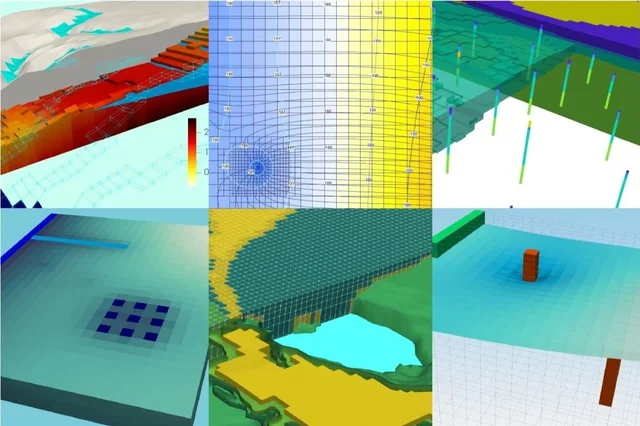
Aquifer Modeling With Feflow And Python
Published 7/2025
Created by Matteo Mirabilio
MP4 | Video: h264, 1280x720 | Audio: AAC, 44.1 KHz, 2 Ch
Level: Beginner | Genre: eLearning | Language: English | Duration: 12 Lectures ( 3h 57m ) | Size: 1.75 GB
Acquifer Modellling : how prevent pollutant dispersion, predict flows and collection regimes
What you'll learn
Basic Concept and Parameters of Acquifer
Acquifer Model in Feflow and Python
Modelling in Feflow and Python of the dispersion of pollutants
Modelling with Python for dranaige and suistanability captivity
Requirements
Hydrology
Physics
Description
This course offers a comprehensive introduction to aquifer modelling, focusing on strategies to prevent pollutant dispersion, predict groundwater flow, and design effective collection regimes. Participants will explore the principles of hydrogeology, aquifer types (confined, unconfined, fractured), and contaminant transport mechanisms. Through theoretical lessons and practical case studies, the course highlights how numerical models (e.g., MODFLOW, FEFLOW) can simulate flow patterns, contaminant migration, and recharge-discharge dynamics under various conditions.A key emphasis is placed on identifying pollution sources, assessing risks, and implementing barrier systems or extraction wells to limit contaminant spread. Participants will learn to integrate monitoring data, boundary conditions, and hydraulic properties into models to support decision-making for groundwater protection and sustainable water use.The course also covers predictive modelling for different collection regimes, optimizing well placement, pumping rates, and remediation strategies. By the end of the course, attendees will be able to build and validate aquifer models, interpret results, and apply them to prevent pollutant dispersion, guide remediation planning, and ensure regulatory compliance. This course is designed for environmental engineers, hydrogeologists, and water resource managers aiming to safeguard groundwater quality and availability. Finally you are able to produce a dispersion map, make qualitative analysis, and modelling the suistenability of drainage and catchment works.
Who this course is for
Geologist
Hydrogelogist
https://rapidgator.net/file/2679a9e455f3dc26bd5318038c64d62c/Aquifer_Modeling_with_Feflow_and_Python.part2.rar.html
https://rapidgator.net/file/c788a2c030e7d3ecd5df11ead1a17e78/Aquifer_Modeling_with_Feflow_and_Python.part1.rar.html
https://nitroflare.com/view/A55139DD1C82BA8/Aquifer_Modeling_with_Feflow_and_Python.part2.rar
https://nitroflare.com/view/F9812B0446146D4/Aquifer_Modeling_with_Feflow_and_Python.part1.rar
We need your support!
Make a donation to help us stay online

Bitcoin (BTC)
bc1q08g9d22cxkawsjlf8etuek2pc9n2a3hs4cdrld

Bitcoin Cash (BCH)
qqvwexzhvgauxq2apgc4j0ewvcak6hh6lsnzmvtkem

Ethereum (ETH)
0xb55513D2c91A6e3c497621644ec99e206CDaf239

Litecoin (LTC)
ltc1qt6g2trfv9tjs4qj68sqc4uf0ukvc9jpnsyt59u

USDT (ERC20)
0xb55513D2c91A6e3c497621644ec99e206CDaf239

USDT (TRC20)
TYdPNrz7v1P9riWBWZ317oBgJueheGjATm
Information |
|||
 |
Users of GUESTS are not allowed to comment this publication. | ||