


Udemy – Game Level Design Player Experience & Spatial Storytelling
Category: Tutorials
- views: 69
- date: 5 July 2025
- posted by: voska89
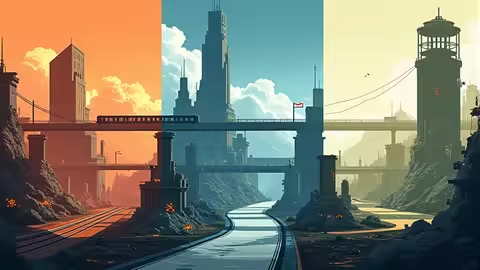
Free Download Udemy – Game Level Design Player Experience & Spatial Storytelling
Published 5/2025
MP4 | Video: h264, 1920x1080 | Audio: AAC, 44.1 KHz
Language: English | Size: 1.73 GB | Duration: 4h 33m
Explore theoretical principles of player engagement and spatial narrative to craft immersive, accessible game levels.
What you'll learn
Apply Flow theory and difficulty curve analysis to design engaging, immersive game levels that balance challenge and player skill.
Design feedback systems and reward mechanics using visual, auditory, and haptic cues to reinforce player actions and drive exploration.
Construct spatial narratives through environment design, object placement, and visual signposting without relying on text or explicit UI elements.
Integrate accessibility and inclusive design strategies to create barrier-free, enjoyable gameplay experiences for diverse audiences.
Requirements
Basic understanding of game design principles; prior experience with a game engine (Unity, Unreal, or equivalent); familiarity with level editing tools and 3D navigation; a computer with relevant software installed.
Description
Welcome to "Game Level Design: Player Experience & Spatial Storytelling", a comprehensive exploration of the theoretical underpinnings that drive player engagement and environmental narrative. Over the span of this course, you will be guided through foundational psychological concepts, spatial storytelling techniques, and advanced case studies that collectively equip you to design levels that resonate on emotional and cognitive levels.In Chapter 2, we delve into the Foundations of Player Experience. You will learn to analyze emotional, cognitive, and social factors that shape player journeys. Through an examination of Csikszentmihalyi's Flow theory, you will discover how to balance challenge and skill to sustain immersion. We will explore difficulty curves and pacing models that adapt to diverse abilities, and design feedback systems that employ visual, auditory, and haptic responses to reinforce actions and guide decision-making. We will also cover intrinsic and extrinsic motivation drivers, emotional design elements, and usability principles that lower cognitive barriers and promote intuitive gameplay. By the end of this section, you will be able to craft reward mechanics, atmospheric cues, and inclusive features that foster meaningful, engaging experiences for all players.Chapter 3 focuses on the Principles of Spatial Storytelling. You will master spatial narrative techniques, treating geometry, architecture, and props as storytelling devices. You will learn methods for designing environments that communicate lore and character arcs without reliance on text. Sightlines, landmarks, and signposting will become tools to guide players naturally while preserving autonomy. You will examine visual language—color, lighting, contrast—and learn to pace exploration through varied spatial configurations, from tight corridors to open arenas, to produce emotional arcs. Additionally, you will explore thematic consistency, world cohesion, diegetic versus non-diegetic storytelling, and how to integrate narrative seamlessly into mechanics such as puzzles, traversal, and combat.In Chapter 4, we push into Advanced Concepts and Case Studies. You will study emergent gameplay driven by interacting systems, learn to design non-linear level structures that offer players meaningful choices, and balance open and closed spaces to optimize tension and narrative clarity. Environmental variety and modular design strategies will be covered, showing how varied biomes and alternate layouts encourage replayability. You will investigate immersive atmospherics—dynamic lighting, soundscapes, weather systems—and their role in heightening emotional impact. By examining iconic game levels, you will identify best practices and design patterns to inform your own work. Finally, you will integrate all concepts to outline a theoretical prototype level, detailing mechanics, narrative beats, and environmental presentation.Chapter 5 wraps up with a comprehensive summary and next steps. You will revisit the key theoretical principles of player experience and spatial storytelling covered throughout the course, celebrate your progress, and receive guidance on further reading, practical exercises, and community resources to support your ongoing growth. By completing this course, you will have a robust framework for designing player-centric, narratively rich levels ready for real-world implementation. Whether your goal is to create compelling single-player campaigns, dynamic multiplayer arenas, or experimental indie projects, you will leave with both the theoretical knowledge and conceptual tools to innovate in the field of game level design. Enroll now to begin your journey toward crafting immersive and meaningful gameplay experiences.
Overview
Section 1: Intro
Lecture 1 Hello and Course Overview
Section 2: Foundations of Player Experience
Lecture 2 Understanding Player Experience
Lecture 3 The Psychology of Flow
Lecture 4 Challenge, Skill and Difficulty Curves
Lecture 5 Feedback Systems and Rewards
Lecture 6 Engagement and Player Motivation
Lecture 7 Emotional Design and Atmosphere
Lecture 8 Usability, Affordances and Intuitiveness
Lecture 9 Accessibility and Inclusivity in Level Design
Section 3: Principles of Spatial Storytelling
Lecture 10 Spatial Narratives
Lecture 11 Environment as Storyteller
Lecture 12 Player Guidance and Flow
Lecture 13 Visual Language and Signposting
Lecture 14 Pacing Through Spatial Design
Lecture 15 Thematic Consistency and World Cohesion
Lecture 16 Diegetic vs Non-Diegetic Storytelling
Lecture 17 Integrating Narrative with Mechanics
Section 4: Advanced Concepts & Case Studies
Lecture 18 Emergent Gameplay and Systems Thinking
Lecture 19 Non-Linear Level Structures
Lecture 20 Balancing Open and Closed Spaces
Lecture 21 Environmental Variety and Replayability
Lecture 22 Immersion through Atmospherics
Lecture 23 Iconic Level Analysis
Lecture 24 Synthesizing Concepts for Prototype Design
Section 5: Summary and Next Steps
Lecture 25 Course Summary and Next Steps
This course is intended for game designers, level designers, narrative designers, and aspiring developers who want to master theoretical principles of player experience and spatial storytelling to craft more engaging game environments.
Homepage
https://www.udemy.com/course/game-level-design-player-experience-spatial-storytelling/DOWNLOAD LINK
Rapidgator
vleik.Game.Level.Design.Player.Experience..Spatial.Storytelling.part2.rar.html
vleik.Game.Level.Design.Player.Experience..Spatial.Storytelling.part1.rar.html
Fikper
vleik.Game.Level.Design.Player.Experience..Spatial.Storytelling.part2.rar.html
vleik.Game.Level.Design.Player.Experience..Spatial.Storytelling.part1.rar.html
No Password - Links are Interchangeable
We need your support!
Make a donation to help us stay online

Bitcoin (BTC)
bc1q08g9d22cxkawsjlf8etuek2pc9n2a3hs4cdrld

Bitcoin Cash (BCH)
qqvwexzhvgauxq2apgc4j0ewvcak6hh6lsnzmvtkem

Ethereum (ETH)
0xb55513D2c91A6e3c497621644ec99e206CDaf239

Litecoin (LTC)
ltc1qt6g2trfv9tjs4qj68sqc4uf0ukvc9jpnsyt59u

USDT (ERC20)
0xb55513D2c91A6e3c497621644ec99e206CDaf239

USDT (TRC20)
TYdPNrz7v1P9riWBWZ317oBgJueheGjATm
Information |
|||
 |
Users of GUESTS are not allowed to comment this publication. | ||