


Piping Layout For Heat Exchangers
Category: Tutorials
- views: 138
- date: 9 June 2025
- posted by: 0nelove
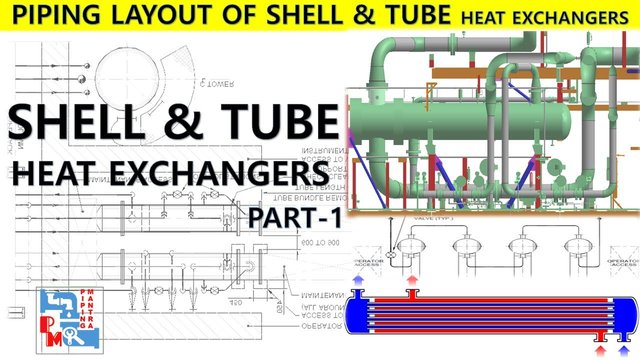
Piping Layout For Heat Exchangers
Last updated 6/2025
MP4 | Video: h264, 1280x720 | Audio: AAC, 44.1 KHz, 2 Ch
Language: English | Duration: 48m | Size: 337 MB
All about Exchanger Piping
What you'll learn
Classification of heat exchangers used in process plants
Constructional and operating features of common exchanger types
3D Pictorial representations for better layout understanding
Interesting facts : Optimizing Layout
Tips and interesting facts to optimize heat exchanger layout for space, maintenance, and performance
Requirements
Piping, Oil & Gas awareness
No Software skills required
Description
A heat exchanger is a system used to transfer heat between a source and a working fluid. Heat exchangers are used in both cooling and heating processes. The fluids may be separated by a solid wall to prevent mixing or they may be in direct contact.A heat exchanger is a device that allows heat from a fluid (a liquid or a gas) to pass to a second fluid (another liquid or gas) without the two fluids having to mix together or come into direct contact. If that's not completely clear, consider this. In theory, we could get the heat from the gas jets just by throwing cold water onto them, but then the flames would go out! The essential principle of a heat exchanger is that it transfers the heat without transferring the fluid that carries the heat.You can see heat exchangers in all kinds of places, usually working to heat or cool buildings or helping engines and machines to work more efficiently. Refrigerators and air-conditioners, for example, use heat exchangers in the opposite way from central heating systems: they remove heat from a compartment or room where it's not wanted and pump it away in a fluid to some other place where it can be dumped out of the way. The cooling fluid is completely sealed inside a network of pipes, so it never actually comes into contact with the air: it takes heat energy from the air inside and dumps it in the air outside, but it never mixes directly with that air.All heat exchangers do the same job—passing heat from one fluid to another—but they work in many different ways. The two most common kinds of heat exchanger are the shell-and-tube and plate/fin. In shell and tube heat exchangers, one fluid flows through a set of metal tubes while the second fluid passes through a sealed shell that surrounds them. That's the design shown in our diagram up above. The two fluids can flow in the same direction (known as parallel flow), in opposite directions (counterblow or counter-current), or at right angles (cross flow).1. Classification of Heat ExchangersDirect contact and indirect contact typesRecuperators, regenerators, and moreShell & Tube, Plate-type, Spiral, Finned Tube2. Constructional and Operating FeaturesComponents and internal structure of various exchangersFlow arrangements: counterflow, parallel flow, crossflowMaintenance and operating considerations3. Layout Aspects for Each Exchanger TypeShell & Tube Heat ExchangerPlate Type Heat ExchangerSpiral Heat ExchangerKey layout differences and constraints for each type4. 3D Pictorial ViewsRealistic visualizations of piping around exchangersNozzle orientation, access clearance, and supportingPlacement relative to other equipment5. Interesting Facts and Optimization TipsSpace-saving layout tricksAccessibility and safety considerationsCommon layout mistakes and how to avoid them
Who this course is for
Piping and Layout Engineers
Mechanical Engineers in the oil, gas, and chemical sectors
Project and Design Engineers working on EPC projects
Engineering students focused on process plant design
Buy Premium From My Links To Get Resumable Support and Max Speed
https://rapidgator.net/file/284e2e1bf7ed292e1c82a34496885801/Piping_Layout_for_Heat_Exchangers.rar.html
https://nitroflare.com/view/99D50DC7435DEB1/Piping_Layout_for_Heat_Exchangers.rar
https://rapidgator.net/file/284e2e1bf7ed292e1c82a34496885801/Piping_Layout_for_Heat_Exchangers.rar.html
https://nitroflare.com/view/99D50DC7435DEB1/Piping_Layout_for_Heat_Exchangers.rar
We need your support!
Make a donation to help us stay online

Bitcoin (BTC)
bc1q08g9d22cxkawsjlf8etuek2pc9n2a3hs4cdrld

Bitcoin Cash (BCH)
qqvwexzhvgauxq2apgc4j0ewvcak6hh6lsnzmvtkem

Ethereum (ETH)
0xb55513D2c91A6e3c497621644ec99e206CDaf239

Litecoin (LTC)
ltc1qt6g2trfv9tjs4qj68sqc4uf0ukvc9jpnsyt59u

USDT (ERC20)
0xb55513D2c91A6e3c497621644ec99e206CDaf239

USDT (TRC20)
TYdPNrz7v1P9riWBWZ317oBgJueheGjATm
Information |
|||
 |
Users of GUESTS are not allowed to comment this publication. | ||