


Working with Hierarchies in SQL Server
Category: Tutorials
- views: 139
- date: 27 June 2024
- posted by: AD-TEAM
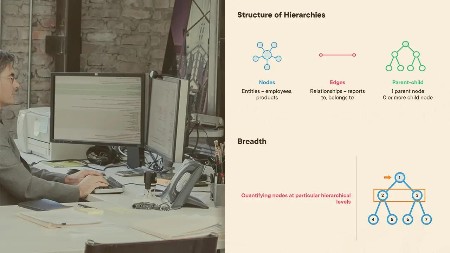
Working with Hierarchies in SQL Server
Duration: 49m | .MP4 1280x720, 30 fps(r) | AAC, 48000 Hz, 2ch | 137 MB
Genre: eLearning | Language: English
In this course, you will learn to work with hierarchical data in SQL Server using hierarchyid. You will master techniques to create, query, optimize, and traverse hierarchies efficiently.
Understanding the HierarchyID data type in SQL Server is crucial for managing hierarchical or nested data structures, enhancing the efficiency and performance of database queries. In this course, Working with Hierarchies in SQL Server, you'll gain
the ability to work with hierarchical data in SQL Server effectively.
First, you'll understand hierarchies' importance, structure, and
representation, focusing on the hierarchyid data type. By creating
hierarchies, querying them, and comparing hierarchyid with other
hierarchy models, you'll gain a robust foundation.
Next, you'll explore node properties like depth, breadth, and
position and learn to find descendants, modify nodes, and calculate
depth and breadth through practical exercises.
Finally, you'll learn to improve performance with indexes, enforce
integrity with triggers, and discuss best practices in SQL Server
hierarchies.
By the end of this course, you'll have both theoretical understanding
and hands-on experience with hierarchical data in SQL Server. You'll
be prepared to handle complex data relationships efficiently,
applying these skills in real-world scenarios.
More Info
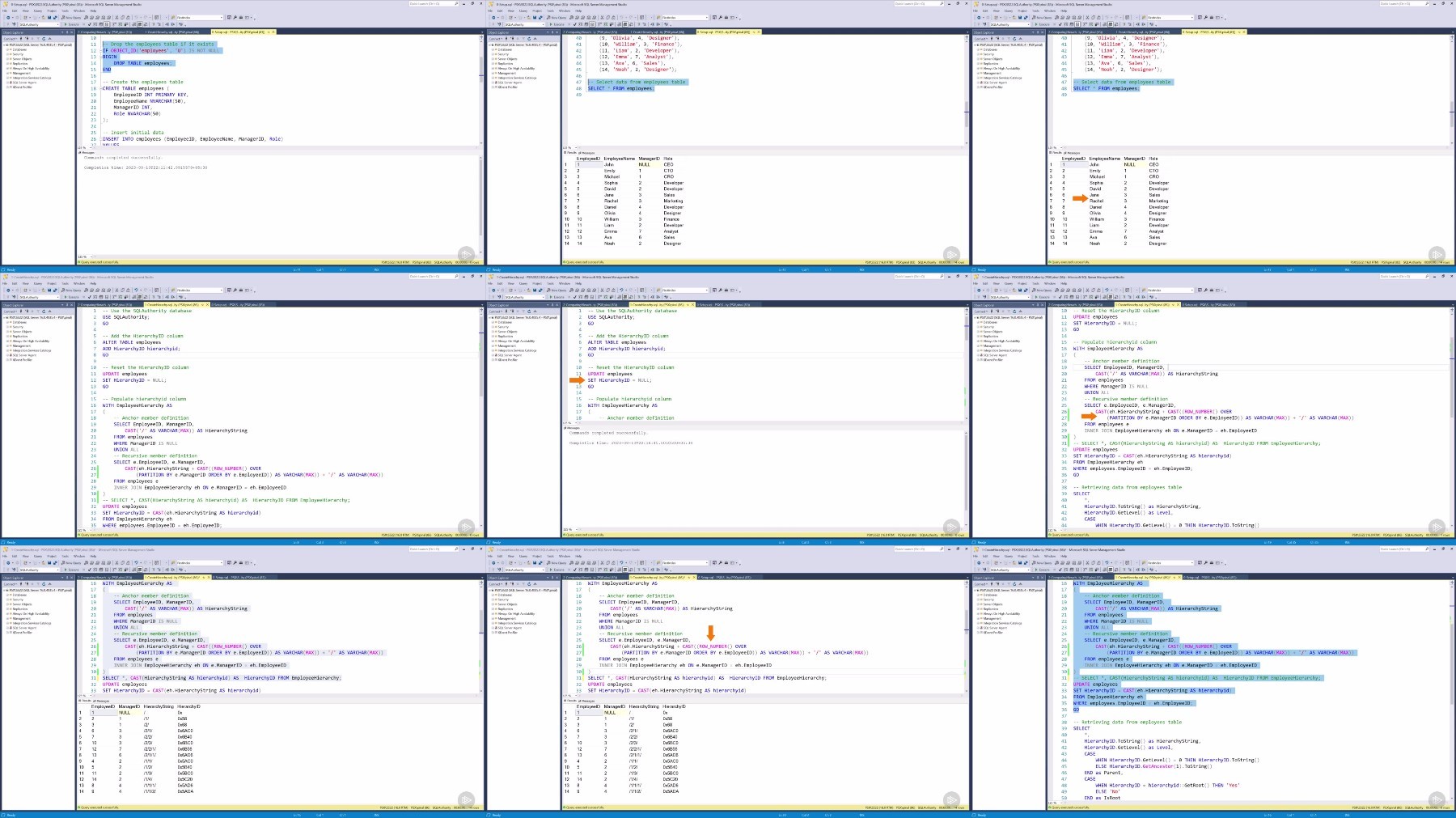
Understanding the HierarchyID data type in SQL Server is crucial for managing hierarchical or nested data structures, enhancing the efficiency and performance of database queries. In this course, Working with Hierarchies in SQL Server, you'll gain
the ability to work with hierarchical data in SQL Server effectively.
First, you'll understand hierarchies' importance, structure, and
representation, focusing on the hierarchyid data type. By creating
hierarchies, querying them, and comparing hierarchyid with other
hierarchy models, you'll gain a robust foundation.
Next, you'll explore node properties like depth, breadth, and
position and learn to find descendants, modify nodes, and calculate
depth and breadth through practical exercises.
Finally, you'll learn to improve performance with indexes, enforce
integrity with triggers, and discuss best practices in SQL Server
hierarchies.
By the end of this course, you'll have both theoretical understanding
and hands-on experience with hierarchical data in SQL Server. You'll
be prepared to handle complex data relationships efficiently,
applying these skills in real-world scenarios.
More Info
We need your support!
Make a donation to help us stay online

Bitcoin (BTC)
bc1q08g9d22cxkawsjlf8etuek2pc9n2a3hs4cdrld

Bitcoin Cash (BCH)
qqvwexzhvgauxq2apgc4j0ewvcak6hh6lsnzmvtkem

Ethereum (ETH)
0xb55513D2c91A6e3c497621644ec99e206CDaf239

Litecoin (LTC)
ltc1qt6g2trfv9tjs4qj68sqc4uf0ukvc9jpnsyt59u

USDT (ERC20)
0xb55513D2c91A6e3c497621644ec99e206CDaf239

USDT (TRC20)
TYdPNrz7v1P9riWBWZ317oBgJueheGjATm
Information |
|||
 |
Users of GUESTS are not allowed to comment this publication. | ||