


Mastering Neural Style Transfer Tensorflow, Keras & Python
Category: Tutorials
- views: 152
- date: 12 July 2023
- posted by: voska89
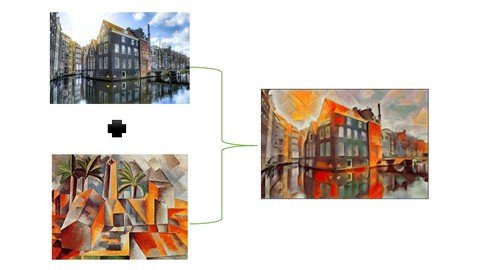
Free Download Mastering Neural Style Transfer Tensorflow, Keras & Python
Published 7/2023
MP4 | Video: h264, 1280x720 | Audio: AAC, 44.1 KHz
Language: English | Size: 373.80 MB | Duration: 1h 22m
Hands-on Neural Style Transfer: Creating Artistic Images using Tensorflow, Keras, Python, and Google Colab
What you'll learn
Understand Neural Style Transfer and its application in combining content and style in images.
Learn to implement Neural Style Transfer algorithms using Python and Keras.
Gain proficiency in image preprocessing techniques and using pre-trained models like VGG19.
Understand the concept of loss functions and their role in style transfer optimization.
Acquire skills in optimizing style transfer using an optimizer with learning rate decay.
Learn to save and display generated images during the optimization process.
Gain practical experience in implementing Neural Style Transfer algorithms.
Requirements
Familiarity with Python programming language (basic knowledge is sufficient)
Description
Welcome to the exciting world of Neural Style Transfer! In this comprehensive course, you will embark on a journey to master the art of transforming ordinary images into captivating artworks using cutting-edge techniques. Harness the power of Google Colab, Tensorflow, Keras, and Python to unlock your creativity and unleash the potential of Neural Style Transfer.Throughout this course, you will delve deep into the fascinating realm of artistic image generation. From understanding the fundamentals of Neural Style Transfer to exploring advanced generative adversarial networks, you will gain the knowledge and skills needed to create stunning visual masterpieces.Guided by industry experts, you will learn to leverage the power of Google Colab's cloud computing capabilities to seamlessly execute resource-intensive tasks, allowing you to focus on unleashing your creativity without worrying about hardware limitations.By the end of this course, you will not only possess a deep understanding of Neural Style Transfer and its practical implementation, but you will also have a captivating portfolio of artistic images to showcase your skills. With the demand for AI-driven image manipulation on the rise, this course will equip you with the expertise sought after by employers across various industries.Prepare to step into a world of endless creative possibilities and embark on a rewarding career journey. Enroll now and unlock the door to exciting job opportunities in fields such as graphic design, advertising, entertainment, and more. Let your artistic vision take flight as you become a master of Neural Style Transfer!
Overview
Section 1: Fundamentals
Lecture 1 Introduction
Lecture 2 What is Neural Style Transfer?
Lecture 3 About this Project
Lecture 4 Why Should we Learn?
Lecture 5 Applications
Lecture 6 Why Keras and Python?
Lecture 7 Why Google Colab?
Section 2: Model Building and Prediction
Lecture 8 Setup the Working Directory
Lecture 9 Contents in Directory
Lecture 10 Activate GPU
Lecture 11 Checking the availability and usage of GPUs
Lecture 12 Mount Google Drive to Google Colab
Lecture 13 Necessary library imports
Lecture 14 Setting the directory path
Lecture 15 Displaying the base image and the style reference
Lecture 16 Defining the desired dimensions
Lecture 17 Preprocesses an image
Lecture 18 Convert the generated image back to its original format
Lecture 19 Calculate the Gram matrix
Lecture 20 Calculates the style loss
Lecture 21 Calculates the content loss
Lecture 22 Calculates the total variation loss
Lecture 23 Loading the VGG19
Lecture 24 Creating a dictionary
Lecture 25 Building a feature extraction model
Lecture 26 Define the names of the style layers and the content layer
Lecture 27 Set the weights
Lecture 28 Calculates the total loss
Lecture 29 Computes the loss and gradients
Lecture 30 Set up the optimizer
Lecture 31 Preprocess the base image, style reference image, and combination image
Lecture 32 Perform the style transfer optimization loop
Lecture 33 Save and display the final generated image
Beginners interested in deep learning and computer vision,Students studying computer science, artificial intelligence, or related fields,Professionals looking to enhance their skills in neural style transfer and generative adversarial networks,Developers interested in learning how to implement image processing techniques using Python and Keras,Individuals with a curiosity for creative applications of artificial intelligence in the field of image generation and style transfer
Homepage
https://www.udemy.com/course/style-transfer/DOWNLOAD LINK
No Password - Links are Interchangeable
We need your support!
Make a donation to help us stay online

Bitcoin (BTC)
bc1q08g9d22cxkawsjlf8etuek2pc9n2a3hs4cdrld

Bitcoin Cash (BCH)
qqvwexzhvgauxq2apgc4j0ewvcak6hh6lsnzmvtkem

Ethereum (ETH)
0xb55513D2c91A6e3c497621644ec99e206CDaf239

Litecoin (LTC)
ltc1qt6g2trfv9tjs4qj68sqc4uf0ukvc9jpnsyt59u

USDT (ERC20)
0xb55513D2c91A6e3c497621644ec99e206CDaf239

USDT (TRC20)
TYdPNrz7v1P9riWBWZ317oBgJueheGjATm
Information |
|||
 |
Users of GUESTS are not allowed to comment this publication. | ||