


Flood Frequency Analysis Using Glofas Dataset
Category: Tutorials
- views: 89
- date: 25 April 2023
- posted by: voska89
Published 4/2023
MP4 | Video: h264, 1280x720 | Audio: AAC, 44.1 KHz
Language: English | Size: 714.11 MB | Duration: 1h 21m
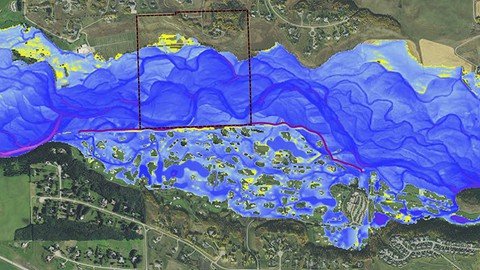
Estimation of the probability of different flood events occurring at a particular location
Free Download What you'll learn
Learning How to Download Streamflow Datasets based on the Global Flood Awareness System (GloFAS)
Learning How to View and Extract Timeseries of NetCDF files in QGIS
Estimation of Annual Maximum peak discharges for a Long Term dataset in Excel
Fitting Different Probability Density Functions (PDFs) to Annual Maximum peak discharges and Determining the Best PDF
Calculating Floods With Different Return Periods (Such as 10, 25, 50, 100, 500, 1000)
Extracting the Relationship Between Floods with Different Return Periods and Floods Values
Requirements
Basic Knowledge about Statistic and Hydrology
Description
Flood frequency analysis is a statistical method used to estimate the probability of different flood events occurring at a particular location. It is an important tool for flood risk management and involves analyzing historical flood data to determine the probability of different flood magnitudes occurring in the future.The first step in flood frequency analysis is to gather data on past floods, such as their magnitude and frequency. This data is then used to calculate the probability of different flood magnitudes occurring in the future using probability distributions.The most commonly used probability distribution in flood frequency analysis is the Gumbel distribution, which is based on extreme value theory. Other distributions, such as the Log-Pearson Type III distribution, can also be used depending on the nature of the flood data.Once the probability distributions have been calculated, they can be used to estimate the probability of different flood magnitudes occurring in a given time period, such as the 25-year, 100-year, or 1000-year floods. This information is used to determine flood risk and inform flood risk management strategies, such as the design of flood protection infrastructure.It's worth noting that flood frequency analysis is not without limitations and uncertainties. The accuracy of the results depends on the quality and quantity of historical flood data available, and there is always a degree of uncertainty associated with predicting rare or extreme events. Additionally, climate change and land use changes can impact flood frequency and magnitude, making accurate predictions more difficult.In this course, all details about FFA, downloading the GloFAS dataset from the Copernicus database in NetCDF format, Extracting daily flow time series from NetCDF in QGIS, Extraction of Annual Maximum Peak Discharges in Excel from Long Term dataset, Importing Annual Maximum Peak Discharges into EasyFit software, Fitting different Probability Distribution Functions to Annual Maximum Peak Discharges and selecting best PDF, Calculation of Flood for different probability values.
Overview
Section 1: Introduction
Lecture 1 Introduction to Flood Frequency Analysis (FFA) and GloFAS dataset
Lecture 2 FFA Presentation File
Section 2: Downloading GloFAS dataset from Copernicus and Extracting Timeseries in QGIS
Lecture 3 Downloading GloFAS dataset
Section 3: Performing Flood Frequency Analysis in Easy fit Software
Lecture 4 Performing Flood Frequency Analysis in Easy fit Software
Section 4: Softwares and Datasets for this Course
Lecture 5 Easy Fit Software
This course is useful for Hydrologist, Water Resources Engineers, River Engineers, Civil and Water Engineering Students
Homepage
https://www.udemy.com/course/flood-frequency-analysis-using-glofas-dataset/DOWNLOAD LINK
Links are Interchangeable - Single Extraction
We need your support!
Make a donation to help us stay online

Bitcoin (BTC)
bc1q08g9d22cxkawsjlf8etuek2pc9n2a3hs4cdrld

Bitcoin Cash (BCH)
qqvwexzhvgauxq2apgc4j0ewvcak6hh6lsnzmvtkem

Ethereum (ETH)
0xb55513D2c91A6e3c497621644ec99e206CDaf239

Litecoin (LTC)
ltc1qt6g2trfv9tjs4qj68sqc4uf0ukvc9jpnsyt59u

USDT (ERC20)
0xb55513D2c91A6e3c497621644ec99e206CDaf239

USDT (TRC20)
TYdPNrz7v1P9riWBWZ317oBgJueheGjATm
Information |
|||
 |
Users of GUESTS are not allowed to comment this publication. | ||