


Industrial Applications of Microbial Secondary Metabolites Biotechnological and Commercial Applications
Category: eBooks
- views: 375
- date: 11 July 2026
- posted by: BeMyLove
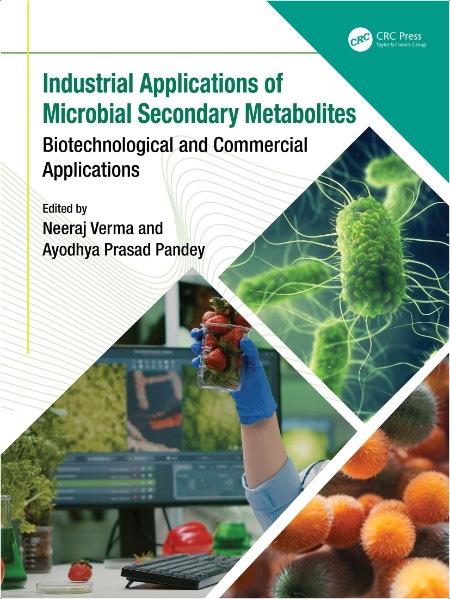
Industrial Applications of Microbial Secondary Metabolites Biotechnological and Commercial Applications | 42.55 MB
Title: Industrial Applications of Microbial Secondary Metabolites Biotechnological and Commercial Applications
Author: Neeraj Verma
Category: Nonfiction, Science & Nature, Science, Biological Sciences, Microbiology, Other Sciences
Language: English | 284 Pages | ISBN: 9781040731277
Description:
This comprehensive volume of Industrial Applications of Microbial Secondary Metabolites: Biotechnological and Commercial Applications offers an in-depth, research-driven overview of microbial secondary metabolites, emphasizing their biosynthesis, functional diversity, and cross-sectoral industrial relevance. All chapters are authored by domain experts. This volume provides a comprehensive examination of microbial secondary metabolites, elucidating their biosynthetic complexity, ecological significance, and translational potential across agricultural, pharmaceutical, industrial, and environmental domains. Secondary metabolites, distinct from primary metabolic products, represent a vast array of structurally diverse and biologically active compounds produced by microorganisms such as bacteria, fungi, and actinomycetes, often under specific environmental or stress-induced conditions. The book investigates their regulatory networks, gene clusters (e.g., PKS, NRPS, and hybrid pathways), and microbial genomics that underpin metabolite production and optimization through advanced metabolic engineering, synthetic biology, and omics-integrated biotechnological platforms.
Early chapters explain the role of secondary metabolites in various industries, detailing current bioprocessing methods for large-scale fermentation, strain improvement strategies, and downstream processing for value-added compounds. The book transitions into agronomic applications, where microbial metabolites act as natural elicitors, phytostimulants, and rhizosphere modulators.
Detailed case studies explore the functional role of secondary metabolites in inducing systemic acquired resistance (SAR) and induced systemic resistance (ISR), modulating phytohormone signaling (e.g., auxin, ethylene, jasmonic acid), and suppressing pathogenic fungi, bacteria, and nematodes through antagonistic metabolites such as lipopeptides, siderophores, VOCs, and antibiotics.
The integration of microbial consortia and bioformulations for sustainable agriculture—including biofertilizers, seed biopriming, and advanced delivery systems—is covered with an emphasis on formulation stability, carrier matrices, and shelf-life enhancement.
The chapters also cover human health applications, including novel antimicrobials, immunomodulatory agents, and nutraceutical compounds derived from Ganoderma and probiotic strains. Industrial sections discuss microbial pigments and fungal-derived dyes as alternatives to synthetic colorants with their physicochemical properties, scalability, and applications in food, pharmaceuticals, and textiles.
Nanotechnology-enabled strategies for metabolite production and delivery, including nano-bioreactors, green nanomanufacturing processes, nanoformulations, and biosensors for agriculture and diagnostics have also been discussed.
The book also covers future trends in biomanufacturing, emphasizing the need for integrated biorefineries, AI-driven strain design, and global harmonization of microbial product commercialization. The regulatory and commercial landscapes are also evaluated, including guidelines for GRAS status, intellectual property, biosafety considerations, and pathway standardization for scale-up.
This book will serve as a valuable reference for researchers, microbiologists, biotechnologists, agricultural scientists, environmental professionals, and industrial stakeholders engaged in microbial biotechnology and allied fields. This compilation will not only support ongoing academic and industrial efforts but also inspire novel research directions.
Constructive feedback and suggestions from valued readers are warmly welcomed and will be thoughtfully considered for inclusion in future editions, ensuring that the content remains current, relevant, and impactful.
DOWNLOAD:
https://rapidgator.net/file/db98e7696b799514d0df018d21edaa03/Industrial_Applications_of_Microbial_Secondary_Metabolites_Biotechnological_and_Commercial_Applications.rar
https://nitroflare.com/view/19F87451DA19A56/Industrial_Applications_of_Microbial_Secondary_Metabolites_Biotechnological_and_Commercial_Applications.rar
We need your support!
Make a donation to help us stay online

Bitcoin (BTC)
bc1q08g9d22cxkawsjlf8etuek2pc9n2a3hs4cdrld

Bitcoin Cash (BCH)
qqvwexzhvgauxq2apgc4j0ewvcak6hh6lsnzmvtkem

Ethereum (ETH)
0xb55513D2c91A6e3c497621644ec99e206CDaf239

Litecoin (LTC)
ltc1qt6g2trfv9tjs4qj68sqc4uf0ukvc9jpnsyt59u

USDT (ERC20)
0xb55513D2c91A6e3c497621644ec99e206CDaf239

USDT (TRC20)
TYdPNrz7v1P9riWBWZ317oBgJueheGjATm
Information |
|||
 |
Users of GUESTS are not allowed to comment this publication. | ||