


Exploring Space with McLuhan Insights for the Digital Age
Category: eBooks
- views: 169
- date: 11 July 2026
- posted by: BeMyLove
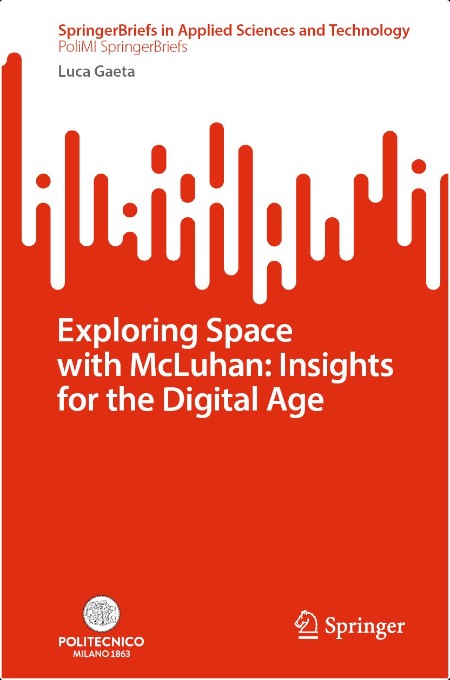
Exploring Space with McLuhan Insights for the Digital Age | 1.42 MB
Title: Exploring Space with McLuhan Insights for the Digital Age
Author: Luca Gaeta
Category: Nonfiction, Reference & Language, Language Arts, Library & Information Services, Fiction & Literature, Literary Theory & Criticism, Education & Teaching
Language: English | 92 Pages | ISBN: 9783032291851
Description:
This book investigates the spatial relations between digital media and society, relying on Marshall McLuhan's probes into the effects of communication technology. It argues that McLuhan's ideas may be relevant to understanding how contemporary space, digital media, and society adapt to one another. This aim is pursued in three steps. First, McLuhan's media theory is discussed with a focus on the effects of media in structuring the conditions of space perception at both the individual and the social levels. The concepts of visual and acoustic space are examined in relation to mechanical and electric media, respectively. Second, McLuhan's lifelong interest in the city as a learning environment is contrasted with his claim that cities are obsolete vis-à-vis the global village of instant electronic communication. The contradiction is more apparent than real, as McLuhan imagined a future for cities as programmed environments for the sensory training of citizens and actively engaged in discussions with urban planners and designers. Third, McLuhan's insights are extended beyond his time to make sense of the current relationship between digital media, space, and urban society. The evolution of cyberspace from a virtual realm to its hybridisation with physical space is traced across both literary and scholarly sources. The effects of a hybrid space concept on urban planning and design approaches in the digital age are explored. McLuhan's legacy, with its humanistic breadth, enables an understanding of the present media ecology that moves beyond the efficiency-oriented paradigm of the smart city discourse. The book bridges technological consciousness and social responsibility in the fields of space theory and spatial planning. It targets an audience that is open to interdisciplinary dialogue between science and the humanities to promote sustainable cities and communities.
DOWNLOAD:
https://rapidgator.net/file/2d617ee043cd4a22cec1e284a56574be/978-3-032-29185-1.rar
https://nitroflare.com/view/C3756D3C3368A95/978-3-032-29185-1.rar
We need your support!
Make a donation to help us stay online

Bitcoin (BTC)
bc1q08g9d22cxkawsjlf8etuek2pc9n2a3hs4cdrld

Bitcoin Cash (BCH)
qqvwexzhvgauxq2apgc4j0ewvcak6hh6lsnzmvtkem

Ethereum (ETH)
0xb55513D2c91A6e3c497621644ec99e206CDaf239

Litecoin (LTC)
ltc1qt6g2trfv9tjs4qj68sqc4uf0ukvc9jpnsyt59u

USDT (ERC20)
0xb55513D2c91A6e3c497621644ec99e206CDaf239

USDT (TRC20)
TYdPNrz7v1P9riWBWZ317oBgJueheGjATm
Information |
|||
 |
Users of GUESTS are not allowed to comment this publication. | ||