


How to Critically Read the Scientific Research Literature Introducing the CERIC Method
Category: eBooks
- views: 89
- date: 27 June 2026
- posted by: BeMyLove
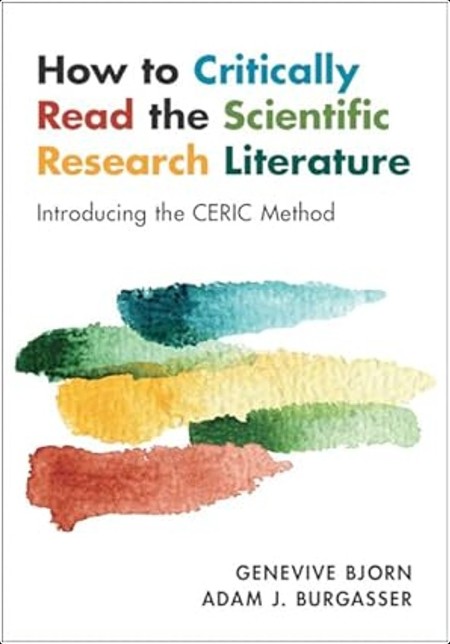
How to Critically Read the Scientific Research Literature Introducing the CERIC Method | 4.52 MB
Title: How to Critically Read the Scientific Research Literature Introducing the CERIC Method
Author: Bjorn, Genevive; Burgasser, Adam J.
Category: Nonfiction, Reference & Language, Education & Teaching, Teaching, Teaching Methods, Science & Nature, Science, Biological Sciences
Language: English | 372 Pages | ISBN: 1009631276
Description:
Given the explosion of information and knowledge in the field of Life Sciences, adapting primary literature as materials in course work as part of active learning seems to be more effective in improving scientific literacy among science undergraduates than the pure transmission of content knowledge using traditional textbooks. In addition, students also read research articles as part of undertaking laboratory research projects useful for preparing them for graduate school. As such, a good grasp of reading and analytical skills is needed for students to understand how their research project contributes to the field that they are working in. Such skills are being taught at UK and USA universities. In Asia, this approach in teaching has not yet been as widespread, although similar ideas are beginning to be used in education. Written as a quick guide for undergraduate students and faculty members dealing with scientific research articles as part of a module or research project, this book will be useful, especially in Asia, for students and faculty members as the universities look to incorporating the use of scientific research articles in their undergraduate teaching.For Life Science students, the first time they encounter a primary literature can be rather daunting, though with proper guidance, they can overcome the initial difficulties and become confident in dealing with scientific articles.This guidebook provides a structured approach to reading a research article, guiding the reader step-by-step through each section, with tips on how to look out for key points and how to evaluate each section.Overall, by helping undergraduate students to overcome their anxieties in reading scientific literature, the book will enable the students to appreciate better the process of scientific investigations and how knowledge is derived in science.
DOWNLOAD:
https://rapidgator.net/file/4ae06dc300d088e71abf4248fd842b2e/How_to_Critically_Read_the_Scientific_Research_Literature_Introducing_the_CERIC_Method.rar
https://nitroflare.com/view/4F5813D5EF9C840/How_to_Critically_Read_the_Scientific_Research_Literature_Introducing_the_CERIC_Method.rar
We need your support!
Make a donation to help us stay online

Bitcoin (BTC)
bc1q08g9d22cxkawsjlf8etuek2pc9n2a3hs4cdrld

Bitcoin Cash (BCH)
qqvwexzhvgauxq2apgc4j0ewvcak6hh6lsnzmvtkem

Ethereum (ETH)
0xb55513D2c91A6e3c497621644ec99e206CDaf239

Litecoin (LTC)
ltc1qt6g2trfv9tjs4qj68sqc4uf0ukvc9jpnsyt59u

USDT (ERC20)
0xb55513D2c91A6e3c497621644ec99e206CDaf239

USDT (TRC20)
TYdPNrz7v1P9riWBWZ317oBgJueheGjATm
Information |
|||
 |
Users of GUESTS are not allowed to comment this publication. | ||