


Company Politics Commerce, Scandal, and French Visions of Indian Empire in the Revolutionary Era
Category: eBooks
- views: 103
- date: 15 June 2026
- posted by: BeMyLove
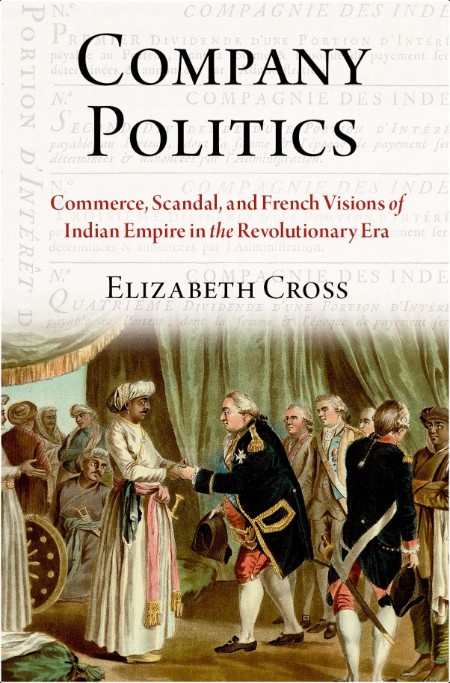
Company Politics Commerce, Scandal, and French Visions of Indian Empire in the Revolutionary Era | 38.13 MB
Title: Company Politics Commerce, Scandal, and French Visions of Indian Empire in the Revolutionary Era
Author: Elizabeth Cross;
Category: Business & Finance, Business Reference, Corporate History, Nonfiction, History, European General
Language: English | 313 Pages | ISBN: 9780197653777
Description:
In the wake of the Seven Years' War and the consolidation of British power on the subcontinent, the French monarchy chartered a new East India Company. The Nouvelle Compagnie des Indes was an attempt to maintain French diplomatic and financial credit among European rivals and trading partners within a region integral to the broader imperial economy. Reimagining French power as subsisting through an informal empire of trade, instead of a territorial empire of conquest, officials and intellectuals sought to remake the trading company as a private, "purely commercial" actor, rather than a sovereign company-state. Company Politics offers a new interpretation of political economy, imperialism, and the history of the corporation during the late Old Regime and the French Revolution. Despite its reputation for speculation, corruption, and scandal, Elizabeth Cross argues that the "New Company" emerged from the unique circumstances France faced in India as a weakened imperial power vis à vis the expanding British East India Company. Seeking to control the Company for their own purposes, French government officials, theorists, and private financial actors clashed over differing notions of political economy, debt, and imperial power for Europe and the Indian Ocean world. In doing so, they envisioned new alignments between state and market, challenged the legitimacy of the Old Regime's economic and imperial policies, and sought to revolutionize the underlying corporation itself through progressive demands of corporate self-governance. Thus, the New Company should be seen as an innovative capitalist actor in its own right, not a mere derivative of its Anglo-Dutch competitors. A valuable contribution to scholarship on capitalism, empire, and globalization, Company Politics uses the Company's history to present the Revolutionary Era as one of dynamic economic ideologies, practices, and experimentation, rather than only one of crisis and decline.
DOWNLOAD:
https://rapidgator.net/file/a4aa03e1fbe7d5df9935be165927b31f/Company_Politics.rar
https://nitroflare.com/view/5FB6AD7B7CF8FA0/Company_Politics.rar
We need your support!
Make a donation to help us stay online

Bitcoin (BTC)
bc1q08g9d22cxkawsjlf8etuek2pc9n2a3hs4cdrld

Bitcoin Cash (BCH)
qqvwexzhvgauxq2apgc4j0ewvcak6hh6lsnzmvtkem

Ethereum (ETH)
0xb55513D2c91A6e3c497621644ec99e206CDaf239

Litecoin (LTC)
ltc1qt6g2trfv9tjs4qj68sqc4uf0ukvc9jpnsyt59u

USDT (ERC20)
0xb55513D2c91A6e3c497621644ec99e206CDaf239

USDT (TRC20)
TYdPNrz7v1P9riWBWZ317oBgJueheGjATm
Information |
|||
 |
Users of GUESTS are not allowed to comment this publication. | ||