


Cellulose Nanomaterials Science and Technology
Category: eBooks
- views: 187
- date: 10 June 2026
- posted by: BeMyLove
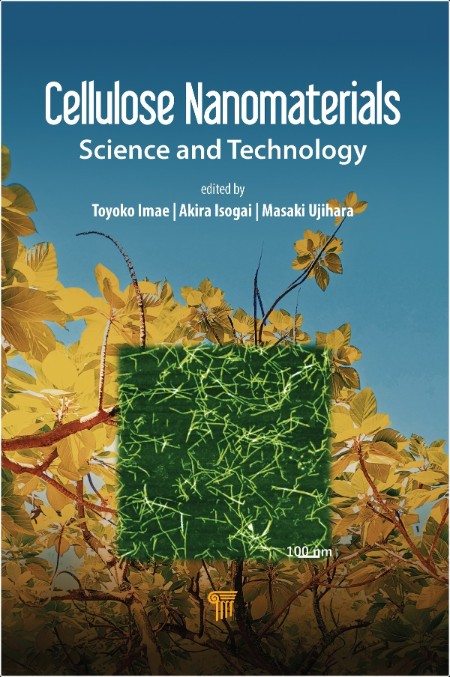
Cellulose Nanomaterials Science and Technology | 89.09 MB
Title: Cellulose Nanomaterials: Science and Technology
Author: Toyoko Imae, Akira Isogai, Masaki Ujihara
Category: Nonfiction, Science & Nature, Technology, Material Science, Science
Language: English | 365 Pages | ISBN: 9815352075
Description:
In today's world, where achieving carbon neutrality and being microplastic-free is imperative, the pursuit of renewable and sustainable materials has become essential. Cellulose nanomaterials (CNs), including cellulose nanofibers (CNFs) and cellulose nanocrystals (CNCs), are nanoscaled materials derived from industrial cellulose fibers (such as paper and dissolving pulps), abundant plants, and other cellulose resources. They are typically produced in water, with or without pretreatment, through downsizing or mechanical fibrillation. CNs retain their original crystal structures, which confer high mechanical strengths and thermal stabilities. In addition, they provide abundant reaction sites for further functionalization, enabling the incorporation of unique properties, such as catalytic activities, anti-microbial effects, hydrophobicity, water resistance, and gas-barrier performance, as well as electronic and thermal functionalities. Thus, CNs represent promising bio-nanomaterials that are biocompatible, biodegradable, sustainable, and renewable. They are abundantly produced by plants through biosynthesis, utilizing atmospheric CO2 and water as primary resources. This book provides a comprehensive overview of CNs, covering their history, chemical structures, morphologies, characteristics, and applications. CNs are expected to be used in food and daily necessities as well as medical, luminescent, electronic, and electrical materials. The book serves as a comprehensive resource not only for university students and researchers, but also for companies and their affiliated engineers as well as for anyone interested in advancing research and developing practical applications of CNs. This book provides a comprehensive overview of CNs, covering their history, chemical structures, morphologies, characteristics, and applications. CNs are expected to be used in food and consumer products as well as medical, luminescent, electronic, and electrical materials.
DOWNLOAD:
https://rapidgator.net/file/13d3db19c708a7b81e569c776d5893f2/Cellulose_Nanomaterials.rar
https://nitroflare.com/view/9C8380EFDC4661F/Cellulose_Nanomaterials.rar
We need your support!
Make a donation to help us stay online

Bitcoin (BTC)
bc1q08g9d22cxkawsjlf8etuek2pc9n2a3hs4cdrld

Bitcoin Cash (BCH)
qqvwexzhvgauxq2apgc4j0ewvcak6hh6lsnzmvtkem

Ethereum (ETH)
0xb55513D2c91A6e3c497621644ec99e206CDaf239

Litecoin (LTC)
ltc1qt6g2trfv9tjs4qj68sqc4uf0ukvc9jpnsyt59u

USDT (ERC20)
0xb55513D2c91A6e3c497621644ec99e206CDaf239

USDT (TRC20)
TYdPNrz7v1P9riWBWZ317oBgJueheGjATm
Information |
|||
 |
Users of GUESTS are not allowed to comment this publication. | ||