


Scientists or Spies The American Museum of Natural History in World War I Latin America
Category: eBooks
- views: 260
- date: 9 May 2026
- posted by: BeMyLove
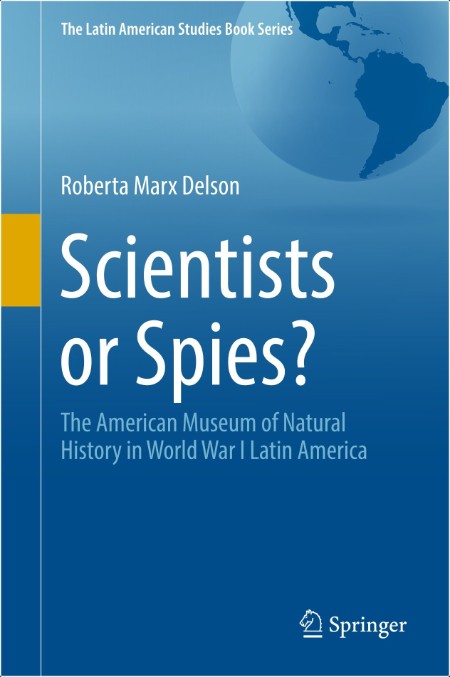
Scientists or Spies The American Museum of Natural History in World War I Latin America | 9.06 MB
Title: Scientists or Spies?
Author: Roberta Marx Delson
Category: Essays, Politics, Science, Nonfiction
Language: angielski | 279 Pages | ISBN: 9780300164381
Description:
In Scientists or Spies, Roberta Delson explores the intersection of three historical tropes: World War I, Science, and Pan Americanism, from the period leading up to and through the end of the War (1910-1919). During this time the boundary between science and politics rapidly dissolved in the United States and world-wide. Using this observation as a starting point, the book examines in depth the specific role played by the American Museum of Natural History (AMNH) in the elision of science with politics. It reveals how the Museum's staff scientists gathered intelligence during wartime in the Latin American nations in which they had previously conducted natural history research.
The book is divided into eleven chapters which trace the growing involvement of the AMNH and its scientists in Latin American politics. The first five chapters of the book highlight the role of AMNH President Henry Fairfield Osborn in focusing on the evolutionary history of mammals in Latin America from the 1890s onward and then supporting the intelligence-gathering activities of his staff there as a way to continue fieldwork activity in wartime. This part of the book also documents the contemporaneous rise of "scientific Pan-Americanism" and the importance of the Second Pan American Scientific Congress of 1915. Chapters VI through X present case studies dealing with the specific experiences of scientists such as ornithologist Frank M. Chapman, ichthyologist Charles Eastman and archaeologist Herbert Spinden, among others, who operated as government intelligence agents in Latin America during World War I.
The last chapter evaluates the results of the Museum's short-lived experiment in permitting science to purposely overlap with politics and considers the implications of the Museum's scientific involvement in Latin America. The book ends in the 1920s when AMNH research in Latin America was severely cut back in favor of expeditions to Asia, and the political involvement of the institution was curtailed.
DOWNLOAD:
https://rapidgator.net/file/908c49c84d5008c9b4e9e5d81b1d6999/Scientists_or_Spies_The_American_Museum_of_Natural_History_in_World_War_I_Latin_America.rar
https://nitroflare.com/view/C6104E7F53E63DC/Scientists_or_Spies_The_American_Museum_of_Natural_History_in_World_War_I_Latin_America.rar
We need your support!
Make a donation to help us stay online

Bitcoin (BTC)
bc1q08g9d22cxkawsjlf8etuek2pc9n2a3hs4cdrld

Bitcoin Cash (BCH)
qqvwexzhvgauxq2apgc4j0ewvcak6hh6lsnzmvtkem

Ethereum (ETH)
0xb55513D2c91A6e3c497621644ec99e206CDaf239

Litecoin (LTC)
ltc1qt6g2trfv9tjs4qj68sqc4uf0ukvc9jpnsyt59u

USDT (ERC20)
0xb55513D2c91A6e3c497621644ec99e206CDaf239

USDT (TRC20)
TYdPNrz7v1P9riWBWZ317oBgJueheGjATm
Information |
|||
 |
Users of GUESTS are not allowed to comment this publication. | ||