


Bellavia A Statistical Methods for Environmental Mixtures A Primer 2025
Category: eBooks
- views: 174
- date: 23 September 2025
- posted by: BeMyLove
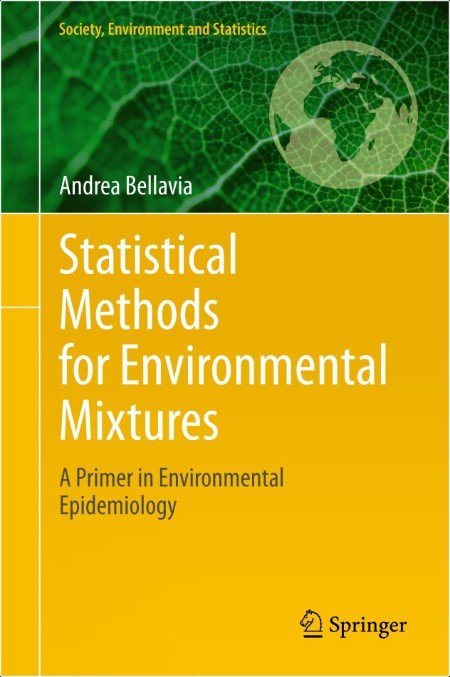
Bellavia A Statistical Methods for Environmental Mixtures A Primer 2025 | 5.18 MB
Title: Statistical Methods for Environmental Mixtures
Author: Andrea Bellavia
Description:
This book provides a comprehensive introduction to statistical approaches for the assessment of complex environmental exposures, such as pollutants and chemical mixtures, within the exposome framework. Environmental mixtures are defined as groups of 3 or more chemical/pollutants, simultaneously present in nature, consumer products, or in the human body. Assessing the health effects of environmental mixtures poses several methodological challenges due to the high levels of correlation that are often present between environmental chemicals, and by the need of incorporating flexible non-additive and non-linear effects that can capture and describe the complex mechanisms by which environmental exposure contribute to diseases. Several statistical approaches are proposed and discussed, including the application of regression-based approaches (e.g. penalized regression such as LASSO and elastic net, or Bayesian variable selection) for environmental exposures, and novel methods (e.g. weighted quantile sum regression, or Bayesian Kernel Machine Regression) that account for specific complexities of environmental exposures. More recent efforts included are the application of machine learning approaches (e.g. gradient boosting) for environmental data.
Statistical Methods for Environmental Mixtures describes the statistical challenges that commonly arise when dealing with environmental exposures and provides an introduction to different statistical approaches for such data. Over the last decade, substantial efforts have been made to transition the statistical framework for environmental exposures in epidemiologic studies from a single-chemical/pollutant to a multi-chemicals/pollutants approach. This book provides a comprehensive introduction to this modern multi-chemicals/pollutants framework. Emphasis is given to interpretability, discussing issues with causal interpretation and translation of scientific finding when applying the discussed statistical approaches for complex environmental exposures.
The target audience includes researchers in environmental epidemiology and applied statisticians working in the field. As such, while rigorously presenting the statistical methodologies, the book keeps an applied focus, discussing those settings where each method is appropriate for use and for which question it can be applied, providing examples of accurate presentation and interpretation from the literature, including a basic introduction to R packages and tutorials, as well as discussing assumptions and practical challenges when applying these techniques on real data.
DOWNLOAD:
https://rapidgator.net/file/8d75d7295e62f56536b7b85ed4e9360a/Bellavia_A._Statistical_Methods_for_Environmental_Mixtures._A_Primer...2025.rar
https://nitroflare.com/view/78465B6883F697E/Bellavia_A._Statistical_Methods_for_Environmental_Mixtures._A_Primer...2025.rar
We need your support!
Make a donation to help us stay online

Bitcoin (BTC)
bc1q08g9d22cxkawsjlf8etuek2pc9n2a3hs4cdrld

Bitcoin Cash (BCH)
qqvwexzhvgauxq2apgc4j0ewvcak6hh6lsnzmvtkem

Ethereum (ETH)
0xb55513D2c91A6e3c497621644ec99e206CDaf239

Litecoin (LTC)
ltc1qt6g2trfv9tjs4qj68sqc4uf0ukvc9jpnsyt59u

USDT (ERC20)
0xb55513D2c91A6e3c497621644ec99e206CDaf239

USDT (TRC20)
TYdPNrz7v1P9riWBWZ317oBgJueheGjATm
Information |
|||
 |
Users of GUESTS are not allowed to comment this publication. | ||