


Electronics for Absolute Beginners
Category: eBooks
- views: 137
- date: 23 August 2025
- posted by: book24h
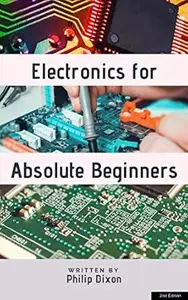
Electronics for Absolute Beginners
English | 2018 | ASIN: B07GDTYJTG | 149 pages | Epub | 10.83 MB
The history of electronics can be traced back to 1874 when Irish scientist George Johnstone Stoney (1826-1911) suggested that electricity must be "built" out of tiny electrical charges. Twenty years later, he coined the name "electron".
Interest in electronics gradually increased over the decades following Stoney's discovery. In 1947 the transistor was invented by William Shockley, John Bardeen and Walter Brattain at Bell Labs, which revolutionized the computer industry by replacing fragile, power hungry valves with much smaller and reliable devices. During the 1950s and 60s, computers became more powerful and smaller, eventually leading to the introduction of the home personal computer (PC) in the 1970s.
Today, electronic devices are all around us ... computers, cell (mobile) phones, televisions, calculators, hearing aids, and cars are just a few examples of devices that form part of everyday life in the 21st century and which make use of electronics.
The purpose of this book is to introduce the subject of electronics to people who have no prior knowledge of the subject. If you don't know what a prototyping breadboard is, or have no idea what a resistor or diode do, then this book will help you to gain a basic understanding of what electronics components exist and what they are used for. You will also learn how to combine such components to build electronics circuits.
Although there is a logical flow in the way that information is presented, you can pretty much jump around from chapter to chapter as it suits you, picking out the material that is of most interest.
The book is split into two parts - the first introduces the subject of electronics, and the second contains a range of simple circuits to design and build.
Part 1 - Getting Started with Electronics
* Chapter 1 - Electricity and Electric Circuits
* Chapter 2 - Equipment You Need in Your Electronics Laboratory
* Chapter 3 - Safety
* Chapter 4 - Resistors
* Chapter 5 - Capacitors
* Chapter 6 - Diodes
* Chapter 7 - Light Emitting Diodes (LEDs)
* Chapter 8 - Transistors
* Chapter 9 - Integrated Circuits
* Chapter 10 - The 555 Timer
* Chapter 11 - Combining Electronics with Software
Part 2 - Designing and Building Electronics Circuits
* Chapter 12 - Using an Electronics Prototyping Breadboard
* Chapter 13 - Illuminating a Single LED
* Chapter 14 - Using a Multimeter to Measure Voltage, Current and Resistance
* Chapter 15 - Connecting Multiple LEDs in Series
* Chapter 16 - Connecting Multiple LEDs in Parallel
* Chapter 17 - Using a Variable Resistor to Control the Speed of a Small DC Motor
* Chapter 18 - Using Wind Power
* Chapter 19 - Using a Transistor to Switch On an LED
* Chapter 20 - Charging and Discharging a Capacitor
* Chapter 21 - Building a Light Sensor - Night Light
* Chapter 22 - Introduction to Solar Power
Buy Premium From My Links To Get Resumable Support,Max Speed & Support Me
Links are Interchangeable - Single Extraction
We need your support!
Make a donation to help us stay online

Bitcoin (BTC)
bc1q08g9d22cxkawsjlf8etuek2pc9n2a3hs4cdrld

Bitcoin Cash (BCH)
qqvwexzhvgauxq2apgc4j0ewvcak6hh6lsnzmvtkem

Ethereum (ETH)
0xb55513D2c91A6e3c497621644ec99e206CDaf239

Litecoin (LTC)
ltc1qt6g2trfv9tjs4qj68sqc4uf0ukvc9jpnsyt59u

USDT (ERC20)
0xb55513D2c91A6e3c497621644ec99e206CDaf239

USDT (TRC20)
TYdPNrz7v1P9riWBWZ317oBgJueheGjATm
Information |
|||
 |
Users of GUESTS are not allowed to comment this publication. | ||