


Festivals in Latin Literature The Poetics of Celebration
Category: eBooks
- views: 71
- date: 14 August 2025
- posted by: BeMyLove
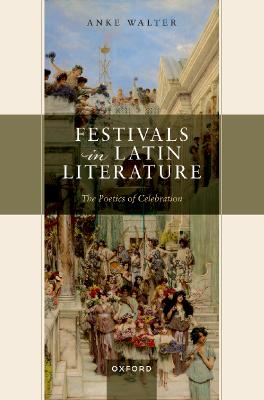
Festivals in Latin Literature The Poetics of Celebration | 2.68 MB
Title: Festivals in Latin Literature
Author: Anke Walter;
Category: Literary Criticism, Nonfiction
Language: English | 589 Pages | ISBN: 978-0198931478
Description:
Festivals feature prominently in Latin literature, even in works that are not explicitly dedicated to festive days like Ovid's Fasti. Festivals in Latin Literature explores the role of festivals in elegiac, lyric, and epic poetry, as well as historiography. In all of these, festivals play a more pervasive role than has so far been realised. Tibullus' elegiac oeuvre rests on an interplay between amatory and festive poetics that even has a political meaning to it, and Propertius uses festivals in his fourth book of elegies to question, from an amatory perspective, the memory typically associated with some key Roman festivals. In the poetry of Sulpicia and Ovid's Tristia, festivals allow voices that are otherwise marginalised to shape their own fame and commemoration. Horace's Odes and the Carmen saeculare rest on an intriguing interplay of festivity in the private sphere, which forms but a fleeting and precious moment, and the monumentality of public festivals, in which the poet styles himself as a master of Roman time. Post-Vergilian Latin epicists use festivals to explore the fragility of human identity in a world dominated by the gods, in Ovid's Metamorphoses, and to question further the commemoration connected with festive days. In particular, Statius in his Thebaid undermines the foundational importance of festivals in the Aeneid, vividly staging the problematic meaning of festivals that convey a premature commemoration of an epic conflict that is unspeakable (nefas). Finally, in Livy's ab urbe condita and Tacitus' Histories, festivals both provide structure and capture long-term developments in Roman history, including Rome's rise to power and the collapse of its morals, while situating both works in broader historiographical and intertextual dialogues.
The book sheds new light on these authors and works, uncovering their unique 'festive poetics'. It demonstrates that Latin literature adds important new aspects to our general understanding of festivals, which, as seen throughout the book, offer even richer avenues of creating meaning and shaping or questioning commemoration than is often assumed.
DOWNLOAD:
https://rapidgator.net/file/1a5545c23814c13b057a2f81012a8443/Festivals_in_Latin_Literature_The_Poetics_of_Celebration.epub
https://clicknupload.click/uhu42etpyknf/Festivals_in_Latin_Literature_The_Poetics_of_Celebration.epub
We need your support!
Make a donation to help us stay online

Bitcoin (BTC)
bc1q08g9d22cxkawsjlf8etuek2pc9n2a3hs4cdrld

Bitcoin Cash (BCH)
qqvwexzhvgauxq2apgc4j0ewvcak6hh6lsnzmvtkem

Ethereum (ETH)
0xb55513D2c91A6e3c497621644ec99e206CDaf239

Litecoin (LTC)
ltc1qt6g2trfv9tjs4qj68sqc4uf0ukvc9jpnsyt59u

USDT (ERC20)
0xb55513D2c91A6e3c497621644ec99e206CDaf239

USDT (TRC20)
TYdPNrz7v1P9riWBWZ317oBgJueheGjATm
Information |
|||
 |
Users of GUESTS are not allowed to comment this publication. | ||