


C++ AI Powerd And Robotic Workbook for Beginners A Guide To Building Simulated Robots and Intelligent Systems
Category: eBooks
- views: 102
- date: 3 August 2025
- posted by: book24h
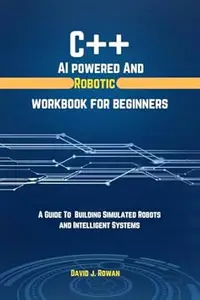
C++ AI Powerd And Robotic Workbook for Beginners : A Guide To Building Simulated Robots and Intelligent Systems (Programming workbooks for Beginner's 1)
English | April 9, 2025 | ASIN: B0F4HL2Y7B | 404 pages | Epub | 251.81 KB
Are you fascinated by the power of Artificial Intelligence and the potential of Robotics, but feel intimidated by the complexity of C++? Do you find other programming books too dry, too theoretical, or completely disconnected from the exciting, cutting-edge applications you really want to build? Have you hesitated to dive into robotics because of the cost and complexity of physical hardware?
If you answered YES, then this is the hands-on, beginner-friendly workbook you've been desperately searching for!
The C++ AI & Robotics Workbook is unlike any other C++ guide. We ditch the dense, academic approach and focus 100% on practical application in the thrilling domains of AI and Robotics, starting from your very first chapter. This is learning by doing at its best!
Here's what makes this book your essential starting point:
Build Intelligent Robots (in Simulation!): Go from zero to programming virtual robots that navigate, sense their environment, make decisions using rules, and find paths around obstacles. No expensive hardware kits required! Learn the core logic on your computer.
AI & Robotics Focus from Day 1: Every C++ concept - variables, loops, functions, classes - is immediately applied to building smarter robots. Understand why you're learning C++ in a context you're passionate about.
"Gentle C++" Approach: We demystify C++ specifically for AI/Robotics beginners. We cut through the noise, focusing only on the essential C++ you need, explained simply and visually. No prior C++ experience? Perfect! This book is designed for you.
Truly Hands-On Workbook Format: This isn't just a book you read. You'll actively code along, tackle engaging exercises, solve debugging challenges, and build increasingly sophisticated projects step-by-step.
Structured Learning Path: We guide you logically from setting up your C++ environment to understanding variables, object-oriented programming (creating your own Robot class!), essential algorithms (like Breadth-First Search for pathfinding), basic rule-based decision-making, and crucial debugging techniques.
Inside, You Will Master How To:
Write clean, effective C++ code specifically for AI and robotics tasks.
Design and implement your own Robot class using Object-Oriented principles.
Program robot movement, sensor interpretation (simulated), and reactions.
Implement fundamental pathfinding algorithms to navigate complex environments.
Create simple rule-based systems (IF-THEN logic) for automated decision-making.
Analyze simulated sensor data to extract meaningful insights.
Debug your code like a pro using practical strategies and tools.
Build a complete, integrated simulation project showcasing your new skills!
Stop letting C++ be the barrier between you and the future of technology. Gain the foundational skills sought after in booming fields like game AI, autonomous systems, simulation, and robotics research - skills highly relevant in tech ecosystems worldwide, from Silicon Valley to Lagos.
This comprehensive workbook provides the clear explanations, practical exercises, and motivating projects you need to succeed.
Buy Premium From My Links To Get Resumable Support,Max Speed & Support Me
Links are Interchangeable - Single Extraction
We need your support!
Make a donation to help us stay online

Bitcoin (BTC)
bc1q08g9d22cxkawsjlf8etuek2pc9n2a3hs4cdrld

Bitcoin Cash (BCH)
qqvwexzhvgauxq2apgc4j0ewvcak6hh6lsnzmvtkem

Ethereum (ETH)
0xb55513D2c91A6e3c497621644ec99e206CDaf239

Litecoin (LTC)
ltc1qt6g2trfv9tjs4qj68sqc4uf0ukvc9jpnsyt59u

USDT (ERC20)
0xb55513D2c91A6e3c497621644ec99e206CDaf239

USDT (TRC20)
TYdPNrz7v1P9riWBWZ317oBgJueheGjATm
Information |
|||
 |
Users of GUESTS are not allowed to comment this publication. | ||