


Open Quantum Systems in Biology, Cognitive and Social Sciences
Category: eBooks
- views: 117
- date: 18 June 2023
- posted by: AD-TEAM
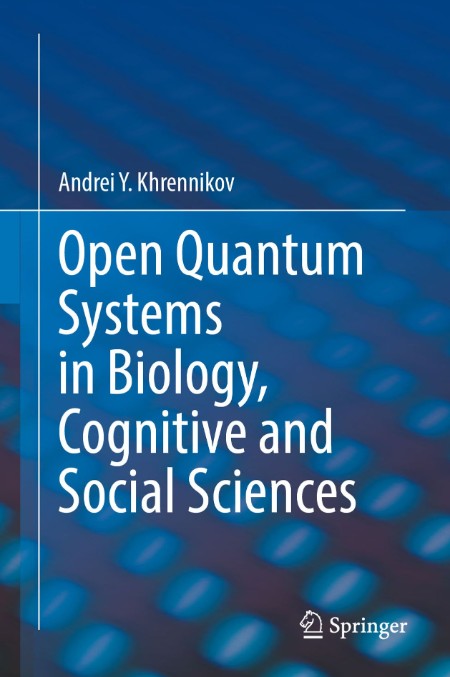
pdf | 5.45 MB | English | Isbn: B0BXWNPRWY | Author: Andrei Y. Khrennikov | Year: 2023
Description:
This book mathematically analyzes the basic problems of biology, decision making and psychology within the framework of the theory of open quantum systems.
In recent years there has been an explosion of interest in applications of quantum theory in fields beyond physics. The main areas include psychology, decision-making, economics, finance, social science as well as genetics and molecular biology. The corresponding models are referred to as quantum-like; they don't concern any genuine physical processes in the human brain.
Quantum-like models reflect the special features of information processing in biological, cognitive, and social systems which match well with the quantum formalism. This formalism gives rise to the quantum probability model (QP) which differs essentially from Kolmogorov's classical probability model. QP also serves as the basis for quantum information theory.
Recently QP has been widely applied to the resolution of the basic paradoxes of decision making theory and to modeling experimental data stemming from cognition, psychology, economics, and finance thereby shedding light on probability fallacies and irrational behavior.
In this book, the theory of quantum instruments and the quantum master equation are applied to the modeling of biological and cognitive processes, in particular, to the stability of complex biological and social systems interacting with their environment. An essential part of the book is devoted to the theory of the social laser and the Fröhlich condensate.


We need your support!
Make a donation to help us stay online

Bitcoin (BTC)
bc1q08g9d22cxkawsjlf8etuek2pc9n2a3hs4cdrld

Bitcoin Cash (BCH)
qqvwexzhvgauxq2apgc4j0ewvcak6hh6lsnzmvtkem

Ethereum (ETH)
0xb55513D2c91A6e3c497621644ec99e206CDaf239

Litecoin (LTC)
ltc1qt6g2trfv9tjs4qj68sqc4uf0ukvc9jpnsyt59u

USDT (ERC20)
0xb55513D2c91A6e3c497621644ec99e206CDaf239

USDT (TRC20)
TYdPNrz7v1P9riWBWZ317oBgJueheGjATm
Information |
|||
 |
Users of GUESTS are not allowed to comment this publication. | ||