


Deep Learning on Microcontrollers:
Category: eBooks
- views: 108
- date: 18 June 2023
- posted by: AD-TEAM
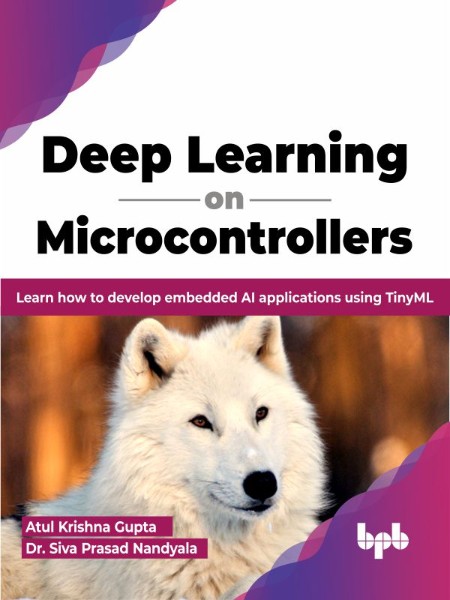
epub | 12.18 MB | English | Isbn: B0C2KQ387T | Author: Atul Krishna Gupta, Dr. Siva Prasad Nandyala | Year: 2023
Description:
A step-by-step guide that will teach you how to deploy TinyML on microcontrollers
Key Features
● Deploy machine learning models on edge devices with ease.
● Leverage pre-built AI models and deploy them without writing any code.
● Create smart and efficient IoT solutions with TinyML.
Description
TinyML, or Tiny Machine Learning, is used to enable machine learning on resource-constrained devices, such as microcontrollers and embedded systems. If you want to leverage these low-cost, low-power but strangely powerful devices, then this book is for you.
This book aims to increase accessibility to TinyML applications, particularly for professionals who lack the resources or expertise to develop and deploy them on microcontroller-based boards. The book starts by giving a brief introduction to Artificial Intelligence, including classical methods for solving complex problems. It also familiarizes you with the different ML model development and deployment tools, libraries, and frameworks suitable for embedded devices and microcontrollers. The book will then help you build an Air gesture digit recognition system using the Arduino Nano RP2040 board and an AI project for recognizing keywords using the Syntiant TinyML board. Lastly, the book summarizes the concepts covered and provides a brief introduction to topics such as zero-shot learning, one-shot learning, federated learning, and MLOps.
By the end of the book, you will be able to develop and deploy end-to-end Tiny ML solutions with ease.
What you will learn
● Learn how to build a Keyword recognition system using the Syntiant TinyML board.
● Learn how to build an air gesture digit recognition system using the Arduino Nano RP2040.
● Learn how to test and deploy models on Edge Impulse and Arduino IDE.
● Get tips to enhance system-level performance.
● Explore different real-world use cases of TinyML across various industries.
Who this book is for
The book is for IoT developers, System engineers, Software engineers, Hardware engineers, and professionals who are interested in integrating AI into their work. This book is a valuable resource for Engineering undergraduates who are interested in learning about microcontrollers and IoT devices but may not know where to begin.
Table of Contents
1. Introduction to AI
2. Traditional ML Lifecycle
3. TinyML Hardware and Software Platforms
4. End-to-End TinyML Deployment Phases
5. Real World Use Cases
6. Practical Experiments with TinyML
7. Advance Implementation with TinyML Board
8. Continuous Improvement
9. Conclusion
Category:Internet Culture, Information Technology, Internet & Telecommunications


We need your support!
Make a donation to help us stay online

Bitcoin (BTC)
bc1q08g9d22cxkawsjlf8etuek2pc9n2a3hs4cdrld

Bitcoin Cash (BCH)
qqvwexzhvgauxq2apgc4j0ewvcak6hh6lsnzmvtkem

Ethereum (ETH)
0xb55513D2c91A6e3c497621644ec99e206CDaf239

Litecoin (LTC)
ltc1qt6g2trfv9tjs4qj68sqc4uf0ukvc9jpnsyt59u

USDT (ERC20)
0xb55513D2c91A6e3c497621644ec99e206CDaf239

USDT (TRC20)
TYdPNrz7v1P9riWBWZ317oBgJueheGjATm
Information |
|||
 |
Users of GUESTS are not allowed to comment this publication. | ||