


Foundations of Probabilistic Logic Programming
Category: eBooks
- views: 218
- date: 26 May 2023
- posted by: AD-TEAM
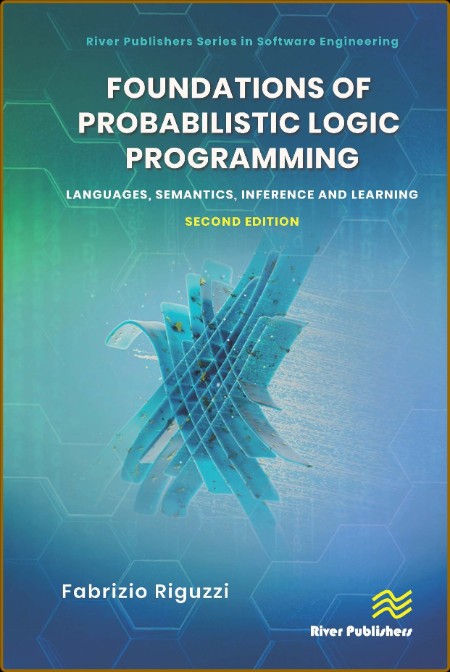
pdf | 41.1 MB | English | ASIN: B07PH3K911 | Author: Fabrizio Riguzzi | Year: 2019
Description:
Probabilistic Logic Programming extends Logic Programming by enabling the representation of uncertain information by means of probability theory. Probabilistic Logic Programming is at the intersection of two wider research fields: the integration of logic and probability and Probabilistic Programming.
Logic enables the representation of complex relations among entities while probability theory is useful for model uncertainty over attributes and relations. Combining the two is a very active field of study. Probabilistic Programming extends programming languages with probabilistic primitives that can be used to write complex probabilistic models. Algorithms for the inference and learning tasks are then provided automatically by the system.
Probabilistic Logic Programming is at the same time a logic language, with its knowledge representation capabilities, and a Turing complete language, with its computation capabilities, thus providing the best of both worlds.
Since its birth, the field of Probabilistic Logic Programming has seen a steady increase of activity, with many proposals for languages and algorithms for inference and learning. Foundations of Probabilistic Logic Programming aims at providing an overview of the field with a special emphasis on languages under the Distribution Semantics, one of the most influential approaches. The book presents the main ideas for semantics, inference, and learning and highlights connections between the methods.
Many examples in the book include a link to a page of the web application http://cplint.eu where the code can be run online.
Category:Software Development, Software Development, Introductory & Beginning Programming

https://nitroflare.com/view/CC6D9F16D5D1C9C/Foundations.of.Probabilistic.Logic.Programming...2ed.rar
We need your support!
Make a donation to help us stay online

Bitcoin (BTC)
bc1q08g9d22cxkawsjlf8etuek2pc9n2a3hs4cdrld

Bitcoin Cash (BCH)
qqvwexzhvgauxq2apgc4j0ewvcak6hh6lsnzmvtkem

Ethereum (ETH)
0xb55513D2c91A6e3c497621644ec99e206CDaf239

Litecoin (LTC)
ltc1qt6g2trfv9tjs4qj68sqc4uf0ukvc9jpnsyt59u

USDT (ERC20)
0xb55513D2c91A6e3c497621644ec99e206CDaf239

USDT (TRC20)
TYdPNrz7v1P9riWBWZ317oBgJueheGjATm
Information |
|||
 |
Users of GUESTS are not allowed to comment this publication. | ||