


The History and Future of Economics
Category: eBooks
- views: 78
- date: 10 May 2023
- posted by: AD-TEAM
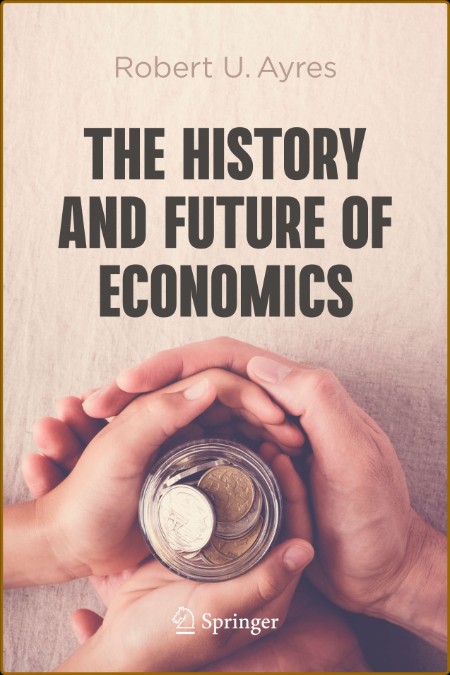
pdf | 8.6 MB | English | Isbn: B0BZCF5QKV | Author: Robert U. Ayres | Year: 2023
Description:
The purpose of this book is three-fold. The first purpose is to posit that the fundamental substance of the universe is energy, and that energy is required (consumed) for any material transformation, or information transmission. The labor theory of value, articulated by the physiats and elaborated by Adam Smith, David Ricardo, J.B. Say and Karl Marx was a rough first approximation of the value creation process, in the 17 th and 18 th centuries, but is now obsolete. Labor is now (mostly) performed by machines, not by humans (or animals).
The second aim of the book is to argue that the economy is a living (open) system -- an "island of order" –that exists far from both thermodynamic and economic equilibrium. Order is achieved by dissipating a flux of exergy. Economists frequently emphasize the equilibrium assumption, introduced originally by Leon Walras in 1854. But in reality, biological systems and human social systems are dissipative cycles, far from both thermodynamic equilibrium, and economic equilibrium, yet stable and capable of evolution, driven by the solar exergy flux.
The third aim of the book is to re-emphasize, that – being open – the economic system cannot be regarded as a collection of individual competitive utility-maximizing transactions. There are, increasingly, important possibilities for cooperation instead of competition. Moreover third party effects, both "bads" (externalities) and the "public good" (happiness) – need to be incorporated into the socio-economic decision making process.

We need your support!
Make a donation to help us stay online

Bitcoin (BTC)
bc1q08g9d22cxkawsjlf8etuek2pc9n2a3hs4cdrld

Bitcoin Cash (BCH)
qqvwexzhvgauxq2apgc4j0ewvcak6hh6lsnzmvtkem

Ethereum (ETH)
0xb55513D2c91A6e3c497621644ec99e206CDaf239

Litecoin (LTC)
ltc1qt6g2trfv9tjs4qj68sqc4uf0ukvc9jpnsyt59u

USDT (ERC20)
0xb55513D2c91A6e3c497621644ec99e206CDaf239

USDT (TRC20)
TYdPNrz7v1P9riWBWZ317oBgJueheGjATm
Information |
|||
 |
Users of GUESTS are not allowed to comment this publication. | ||