


Agrarian Environments Resources, Representations, and Rule in India
Category: eBooks
- views: 182
- date: 12 October 2022
- posted by: voska89
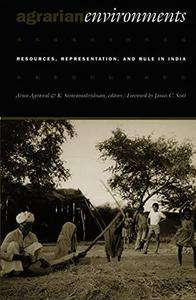
Agrarian Environments: Resources, Representations, and Rule in India By Arun Agrawal (editor), K. Sivaramakrishnan (editor)
2000 | 328 Pages | ISBN: 0822325748 | PDF | 22 MB
Agrarian Environments questions the dichotomies that have structured earlier analyses of environmental processes in India and offers a new way of looking at the relationship between agrarian transformation and environmental change. The contributors claim that attempts to explain environmental conflicts in terms of the local versus the global, indigenous versus outsiders, women versus men, or the community versus the market or state obscure vital dynamics of mobilization and organization that critically influence thought and policy. Editors Arun Agrawal and K. Sivaramakrishnan claim that rural social change in India cannot be understood without exploring how environmental changes articulate major aspects of agrarian transformations-technological, cultural, and political-in the last two centuries. In order to examine these issues, they have reached beyond the confines of single disciplinary allegiances or methodological loyalties to bring together anthropologists, historians, political scientists, geographers, and environmental scientists who are significantly informed by interdisciplinary research. Drawing on extensive field and archival research, the contributors demonstrate the powerful political implications of blurring the boundaries between dichotomous cultural representations, combine conceptual analyses with specific case studies, and look at why competing powers chose to emphasize particular representations of land use or social relations. By providing a more textured analysis of how categories emerge and change, this work offers the possibility of creating crucial alliances across populations that have historically been assumed to lack mutual goals.Agrarian Environments will be valuable to those in political science, Asian studies, and environmental studies.Contributors. Arun Agrawal, Mark Baker, Molly Chattopadhyaya, Vinay Gidwani, Sumit Guha, Shubhra Gururani, Cecile Jackson, David Ludden, Haripriya Rangan, Paul Robbins, Vasant Saberwal, James C. Scott, K. Sivaramakrishnan, Ajay Skaria, Jennifer Springer, Darren Zook
DOWNLOAD LINK


Links are Interchangeable - No Password - Single Extraction
We need your support!
Make a donation to help us stay online

Bitcoin (BTC)
bc1q08g9d22cxkawsjlf8etuek2pc9n2a3hs4cdrld

Bitcoin Cash (BCH)
qqvwexzhvgauxq2apgc4j0ewvcak6hh6lsnzmvtkem

Ethereum (ETH)
0xb55513D2c91A6e3c497621644ec99e206CDaf239

Litecoin (LTC)
ltc1qt6g2trfv9tjs4qj68sqc4uf0ukvc9jpnsyt59u

USDT (ERC20)
0xb55513D2c91A6e3c497621644ec99e206CDaf239

USDT (TRC20)
TYdPNrz7v1P9riWBWZ317oBgJueheGjATm
Information |
|||
 |
Users of GUESTS are not allowed to comment this publication. | ||