


Utamakura, Allusion, and Intertextuality in Traditional Japanese Poetry
Category: eBooks
- views: 111
- date: 24 August 2022
- posted by: voska89
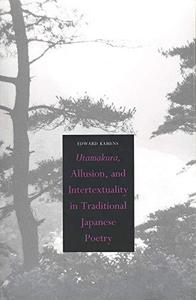
Utamakura, Allusion, and Intertextuality in Traditional Japanese Poetry By Edward Kamens
1997 | 336 Pages | ISBN: 0300068085 | PDF | 24 MB
A central feature of traditional Japanese poetry (waka) is the use of utamakura―a category of poetic words, many of which are place-names or the names of features associated with them―to cultivate allusion and intertextuality between individual poems and within the tradition. In this book Edward Kamens analyzes a wide selection of poems to show how utamakura came to wield special powers within Japanese poetry. He reveals how poets in generation after generation returned, either in person or in imagination, to these places and to poems about them to encounter again the forms, styles, and techniques of their forebears, and to discover ways to create new poems of their own. Kamens focuses especially on one figure, "the buried tree," which refers to fossilized wood associated in particular with an utamakura site, the Natori River, and is mentioned in poems that first appear in anthologies in the early tenth century. The figure surfaces again at many points in the history of traditional Japanese poetry, as do the buried trees themselves in the shallow waters that otherwise conceal them. After explaining and discussing the literary history of the concept of utamakura, Kamens traces the allusive and intertextual development of the figure of the buried tree and the use of the place-name Natorigawa in waka poetry through the late nineteenth century. He investigates the relation between utamakura and the collecting of fetishes and curios associated with utamakura sites by waka connoisseurs. And he analyzes in detail the use of utamakura and their pictorial representations in a political and religious program in an architectural setting―the Saishoshitennoin program of 1207.
DOWNLOAD LINK
Download From UploadCloud
https://www.uploadcloud.pro/h8i34a9ep5cg/7jkio.U.A.a.I.i.T.J.P.rar.html
Download From NovaFile
https://nfile.cc/ojOvKb6q/7jkio.U.A.a.I.i.T.J.P.rar

https://rapidgator.net/file/f12aaca9dfffd3be5c90664f2ab7da02/7jkio.U.A.a.I.i.T.J.P.rar.html

https://nitroflare.com/view/650B80DE3751476/7jkio.U.A.a.I.i.T.J.P.rar

https://uploadgig.com/file/download/bB8909E30bCbc109/7jkio.U.A.a.I.i.T.J.P.rar
https://www.uploadcloud.pro/h8i34a9ep5cg/7jkio.U.A.a.I.i.T.J.P.rar.html
Download From NovaFile
https://nfile.cc/ojOvKb6q/7jkio.U.A.a.I.i.T.J.P.rar
https://rapidgator.net/file/f12aaca9dfffd3be5c90664f2ab7da02/7jkio.U.A.a.I.i.T.J.P.rar.html
https://nitroflare.com/view/650B80DE3751476/7jkio.U.A.a.I.i.T.J.P.rar
https://uploadgig.com/file/download/bB8909E30bCbc109/7jkio.U.A.a.I.i.T.J.P.rar
Links are Interchangeable - No Password - Single Extraction
We need your support!
Make a donation to help us stay online

Bitcoin (BTC)
bc1q08g9d22cxkawsjlf8etuek2pc9n2a3hs4cdrld

Bitcoin Cash (BCH)
qqvwexzhvgauxq2apgc4j0ewvcak6hh6lsnzmvtkem

Ethereum (ETH)
0xb55513D2c91A6e3c497621644ec99e206CDaf239

Litecoin (LTC)
ltc1qt6g2trfv9tjs4qj68sqc4uf0ukvc9jpnsyt59u

USDT (ERC20)
0xb55513D2c91A6e3c497621644ec99e206CDaf239

USDT (TRC20)
TYdPNrz7v1P9riWBWZ317oBgJueheGjATm
Information |
|||
 |
Users of GUESTS are not allowed to comment this publication. | ||