


Varieties of Logic
Category: eBooks
- views: 269
- date: 10 August 2022
- posted by: voska89
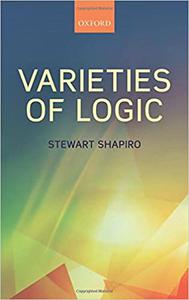
Stewart Shapiro, "Varieties of Logic"
English | ISBN: 0199696527 | 2014 | 240 pages | EPUB | 414 KB
Logical pluralism is the view that different logics are equally appropriate, or equally correct. Logical relativism is a pluralism according to which validity and logical consequence are relative to something. In Varieties of Logic, Stewart Shapiro develops several ways in which one can be a pluralist or relativist about logic. One of these is an extended argument that words and phrases like "valid" and "logical consequence" are polysemous or, perhaps better, are cluster concepts. The notions can be sharpened in various ways. This explains away the "debates" in the literature between inferentialists and advocates of a truth-conditional, model-theoretic approach, and between those who advocate higher-order logic and those who insist that logic is first-order.
A significant kind of pluralism flows from an orientation toward mathematics that emerged toward the end of the nineteenth century, and continues to dominate the field today. The theme is that consistency is the only legitimate criterion for a theory. Logical pluralism arises when one considers a number of interesting and important mathematical theories that invoke a non-classical logic, and are rendered inconsistent, and trivial, if classical logic is imposed. So validity is relative to a theory or structure.
The perspective raises a host of important questions about meaning. The most significant of these concern the semantic content of logical terminology, words like 'or', 'not', and 'for all', as they occur in rigorous mathematical deduction. Does the intuitionistic 'not', for example, have the same meaning as its classical counterpart? Shapiro examines the major arguments on the issue, on both sides, and finds them all wanting. He then articulates and defends a thesis that the question of meaning-shift is itself context-sensitive and, indeed, interest-relative. He relates the issue to some prominent considerations concerning open texture, vagueness, and verbal disputes.
Logic is ubiquitous. Whenever there is deductive reasoning, there is logic. So there are questions about logical pluralism that are analogous to standard questions about global relativism. The most pressing of these concerns foundational studies, wherein one compares theories, sometimes with different logics, and where one figures out what follows from what in a given logic. Shapiro shows that the issues are not problematic, and that is usually easy to keep track of the logic being used and the one mentioned.
Read more
DOWNLOAD LINK
Download From UploadCloud
https://www.uploadcloud.pro/e8ja5jbz5rlp/bisjh.V.o.L.rar.html
Download From NovaFile
https://nfile.cc/7QnMr2pj/bisjh.V.o.L.rar

https://rapidgator.net/file/3a9629424ca6e57780d03b526989e1c9/bisjh.V.o.L.rar.html

https://nitroflare.com/view/D8E137DF3536D81/bisjh.V.o.L.rar

https://uploadgig.com/file/download/162e9b498b57fd2d/bisjh.V.o.L.rar
https://www.uploadcloud.pro/e8ja5jbz5rlp/bisjh.V.o.L.rar.html
Download From NovaFile
https://nfile.cc/7QnMr2pj/bisjh.V.o.L.rar
https://rapidgator.net/file/3a9629424ca6e57780d03b526989e1c9/bisjh.V.o.L.rar.html
https://nitroflare.com/view/D8E137DF3536D81/bisjh.V.o.L.rar
https://uploadgig.com/file/download/162e9b498b57fd2d/bisjh.V.o.L.rar
Links are Interchangeable - No Password - Single Extraction
We need your support!
Make a donation to help us stay online

Bitcoin (BTC)
bc1q08g9d22cxkawsjlf8etuek2pc9n2a3hs4cdrld

Bitcoin Cash (BCH)
qqvwexzhvgauxq2apgc4j0ewvcak6hh6lsnzmvtkem

Ethereum (ETH)
0xb55513D2c91A6e3c497621644ec99e206CDaf239

Litecoin (LTC)
ltc1qt6g2trfv9tjs4qj68sqc4uf0ukvc9jpnsyt59u

USDT (ERC20)
0xb55513D2c91A6e3c497621644ec99e206CDaf239

USDT (TRC20)
TYdPNrz7v1P9riWBWZ317oBgJueheGjATm
Information |
|||
 |
Users of GUESTS are not allowed to comment this publication. | ||