


Japanese Music Harmony The Fundamental Theory of Key Fluctuation
Category: eBooks
- views: 659
- date: 22 July 2022
- posted by: voska89
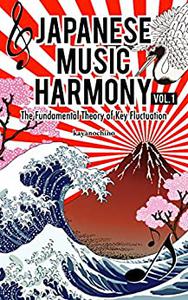
kayano chino, "Japanese Music Harmony: The Fundamental Theory of Key Fluctuation"
English | 2020 | ASIN: B08513234C | EPUB | pages: 43 | 1.9 mb
A music harmony theory book for Japanese modern and traditional music written by Japanese music theorist. It is recommended if you are a music composer or a student interested in Japanese gaming, anime, and J-POP music.
Index
Introduction
Jazz is the goal of popular harmony
Popular harmony does not explain J-POP
Who should read this book
Prerequisite
Composition of this book
Chapter 1: Review of Basic Theory
1. Format and Basic Theory
1. Degree name note
2. Degree name key
3. Degree Chord Name / Triad / Tetrad
4. Tonic chord / Subdominant chord / Dominant chord
5. Tonic key / Subdominant key / Dominant key
2. Extension from "Geidai Harmony"
1. No additional note preparation required
2. Relaxation of limited progress notes and voicing
3. Tolerates dominant chords in natural minor key
4. Parallel fifth and eighth
5. Hidden octave and fifth
6. False relation
7. The sense of resolution
Chapter 2: Theory of Key Fluctuation
1. Melody Structure
1. Melody structure and harmony effect
2. Definition of melody structure
2. Tonal Fluctuation
1. What is the fluctuation of the key?
2. Multipolar tonality
3. Difference from borrowing chord
3. Definitions and Formats
1. Main key
2. Polar key
3. Format of multipolar tonality
4. Format of the chord
5. Format of the note
4. Analyzing Multipolar Tonality
1. Dividing motifs
2. Determining the main key
3. Determining the polar keys
4. Analyzing key mixture
5. Determining the key of the sentence
6. Why bother with "complex" analysis?
7. Prioritizing hearing over theory
8. Sentences starting with a dominant seventh chord
9. Sentences starting with a subdominant chord
10. Composition procedure
5. Types of Key Fluctuations
1. Clear changes at section breaks
2. Clear key change at the end of the section
3. Partial Fluctuation
4. Using different keys simultaneously
6. Extension of Conventional Theory
1. Relaxing chord function rules
2. Relaxation of progression rules from substitute chords to regular chords
3. Relaxation of the limited progression rule
4. Relaxing dominant chord resolution rule
5. Relaxing end chord rule of a section
6. Conclusion
Chapter 3: Sections Without a Fixed Key
1. No Chord
1. Ostinato, riff, solo a cappella
2. Rhythm section, sound effect
3. Atonality
4. Tacet (silence)
2. One-Chord
1. Dominant prolongation, upper structure triad
2. Usage in rap and techno music
3. Two-Chord
1. Creating an atmosphere
2. Producing a primitive feeling
4. Modulation Section
1. Harmonic sequence
2. Modulation with melody pattern
3. Parallel progression of dominant seventh chords on the scale
4. Modulation with scale momentum
Japanese Music Harmony Vol. 1: -The Fundamental Theory of Key Fluctuation-
DOWNLOAD LINK
https://www.uploadcloud.pro/2f6uailp94g6/nhbsq.J.M.H.T.F.T.o.K.F.rar.html

https://uploadgig.com/file/download/506642853fCBaf2c/nhbsq.J.M.H.T.F.T.o.K.F.rar

https://rapidgator.net/file/011c242e1a19702f5722561707453c27/nhbsq.J.M.H.T.F.T.o.K.F.rar.html

https://nitro.download/view/C58C51EBC6EC1DC/nhbsq.J.M.H.T.F.T.o.K.F.rar
Links are Interchangeable - No Password - Single Extraction
We need your support!
Make a donation to help us stay online

Bitcoin (BTC)
bc1q08g9d22cxkawsjlf8etuek2pc9n2a3hs4cdrld

Bitcoin Cash (BCH)
qqvwexzhvgauxq2apgc4j0ewvcak6hh6lsnzmvtkem

Ethereum (ETH)
0xb55513D2c91A6e3c497621644ec99e206CDaf239

Litecoin (LTC)
ltc1qt6g2trfv9tjs4qj68sqc4uf0ukvc9jpnsyt59u

USDT (ERC20)
0xb55513D2c91A6e3c497621644ec99e206CDaf239

USDT (TRC20)
TYdPNrz7v1P9riWBWZ317oBgJueheGjATm
Information |
|||
 |
Users of GUESTS are not allowed to comment this publication. | ||