Eeg/Erp Analysis With Python And Mne: An Introductory Course
Date: 12 July 2025 | Posted by: AD-TEAM
Eeg/Erp Analysis With Python And Mne: An Introductory Course
Published 2/2024
MP4 | Video: h264, 1280x720 | Audio: AAC, 44.1 KHz
Language: English | Size: 3.68 GB | Duration: 7h 51m
From Brain Signal Basics to Advanced Analysis
What you'll learn
Understanding the Basics of Electrophysiology Data
Start Working with Python
Gain Expertise in Frequency Domain Analysis of Electrophysiological Data
Learn to Identify and Analyze ERPs
Acquire the Practical Skills to Conduct Time-Frequency Analysis using Python and the MNE library.
Requirements
No Programming Skill Required. The only software requirement is Anaconda, which is a popular Python distribution that simplifies package management and environment setup. You do not to have it installed in advance, since I will teach how to install and use it during the course. So the only thing you need is a computer and a keyboard!
Description
Whether you're a novice in the field or looking to enhance your skills, this course is your gateway to understanding the basics of EEG data analysis.A Journey Through EEG History: Join us on a fascinating exploration of the origins of EEG data, from its introduction to the cutting-edge techniques used today.Recording EEG dаta: Learn the essentials of recording high-quality EEG data and what constitutes good EEG data. Learn the basics of artifacting, recognizing different types of noises, and witness noise reduction in action through various filtering techniques.Frequency and Time Domain Analyses: Demystify the complexities of frequency and time domain analyses. Understand different brain frequencies, conduct frequency analysis, explore time domain analysis and Event-Related Potentials (ERPs), and venture into time-frequency analysis.Python for EEG Analysis: Familiarize yourself with Python basics, ANACONDA installation, coding fundamentals, and data plotting. Install MNE (MNE-Python) and kickstart your journey into EEG analysis.MNE-Python Pre-processing: Explore MNE-Python for pre-processing EEG data. Import data, gain an overview, implement filtering, reject bad channels, and perform Independent Component Analysis (ICA) for noise removal.Frequency Analysis with Python and MNE: Utilize MNE's PSD function for frequency analysis. Create visually stunning frequency band plots and topographic maps to explore the mysteries hidden within EEG data.Exploring Important ERPs: Review essential Event-Related Potentials (ERPs), such as the P300 and N170 components, along with language-related components. Understand their significance and applications in EEG analysis.ERP and Time-Frequency Analysis in Python and MNE: Master the art of visualizing ERPs using Python. Leverage MNE for interpreting ERPs and delve into plotting and interpreting time-frequency analyses.Why Choose This Course:This course is designed for beginners, providing a seamless transition from the basics to advanced EEG analysis techniques. With hands-on Python coding exercises and practical examples using MNE-Python, you'll gain practical skills that are essential for anyone seeking proficiency in EEG data analysis.Join us on this educational journey, and let's unravel the mysteries of EEG together! Enroll now to kickstart your EEG analysis adventure.
Overview
Section 1: Introduction to EEG
Lecture 1 A short history
Lecture 2 The Origins of EEG data
Lecture 3 How to record EEG
Lecture 4 What is a Good EEG
Section 2: Frequency and time domain analyses
Lecture 5 Different types of brain frequencies
Lecture 6 Frequency analysis
Lecture 7 Time-domain analysis and ERP
Lecture 8 Time-frequency analysis
Section 3: The essence of artifacting
Lecture 9 Different types of noises
Lecture 10 A symphony of noises in action
Lecture 11 Filters
Section 4: Start working with Python
Lecture 12 ANACONDA installation
Lecture 13 Basics of coding-Variables
Lecture 14 Basics of coding-Dictionary
Lecture 15 Working with functions
Lecture 16 Control statements
Lecture 17 Plotting
Lecture 18 MNE Installation
Section 5: Pre-processing with MNE-Python
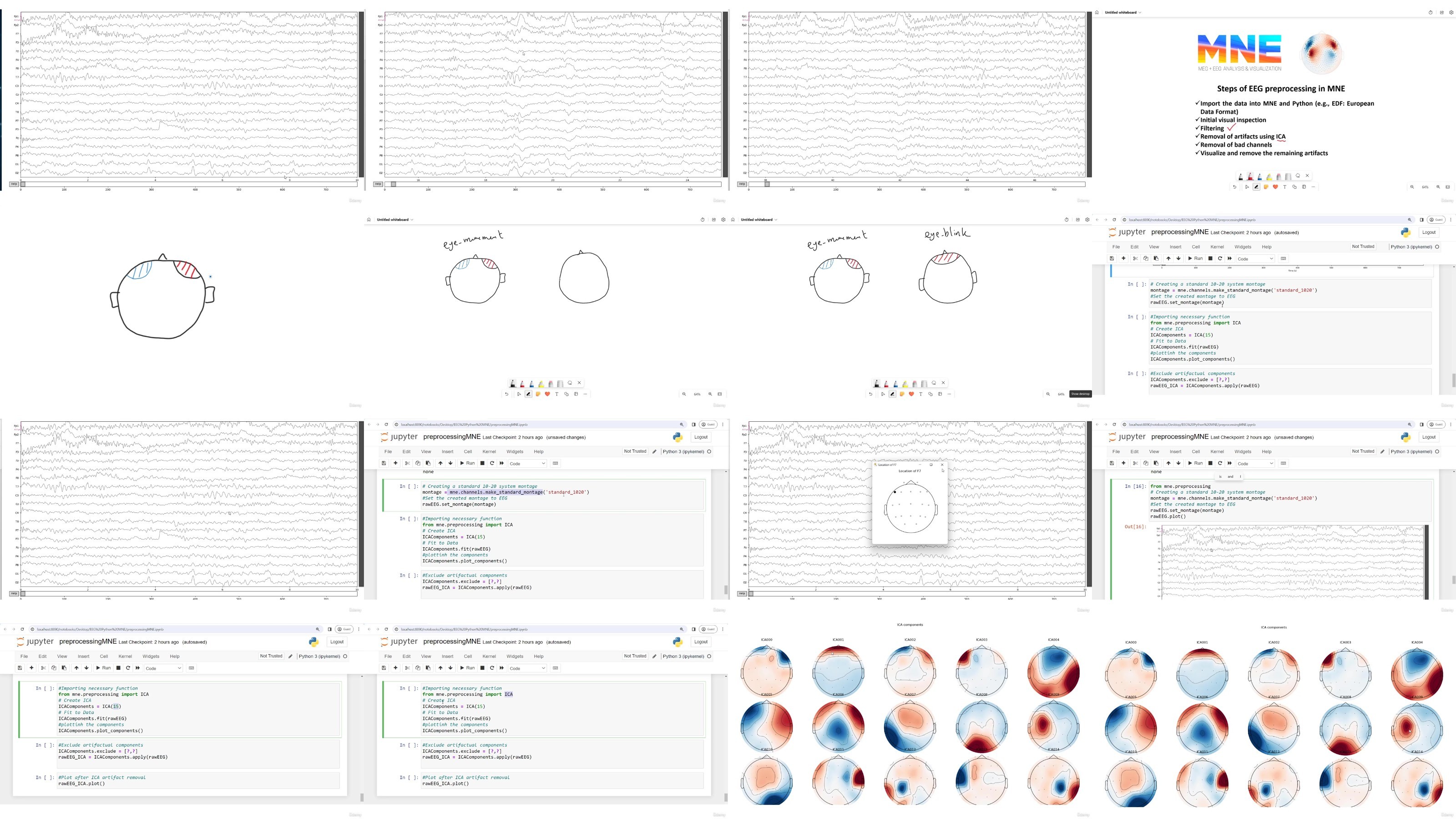
Lecture 19 Importing and reviewing EEG data with MNE
Lecture 20 Filtering the data with MNE
Lecture 21 Saving steps into files
Lecture 22 Removing artifacts considering ICA
Lecture 23 Manual removal of remaining artifacts
Section 6: Frequency analysis in Python and MNE
Lecture 24 Importing EEG in Python
Lecture 25 Frequency analysis in Python with FFT
Lecture 26 Frequency analysis in MNE
Lecture 27 Building custom frequency topographic maps
Section 7: Review of important ERPs
Lecture 28 Time course of stimuli in the brain
Lecture 29 The P300 component
Lecture 30 The N170 component
Lecture 31 The language-related components
Lecture 32 Age and development ERP issues
Section 8: ERP and time-frequency analysis in Python and MNE
Lecture 33 Trial-based EEG data
Lecture 34 Visualize single trials in Python
Lecture 35 Compute mean ERPs in Python
Lecture 36 Structure of EEG data with seperate condition
Lecture 37 Attaching labels to continues EEG data in MNE
Lecture 38 Epoching the events for MNE
Lecture 39 Compute and visualize ERPs in MNE
Lecture 40 Compute and visualze time-frequency in MNE
Lecture 41 Final words
Section 9: Extra+Advance with ChatGPT
Lecture 42 Extra Advance with ChatGPT
Lecture 43 Example
Lecture 44 ChatGPT Prompts
Section 10: Course Materials
Lecture 45 Course Materials
This course is intended for a diverse range of learners who have an interest in electrophysiology data analysis, regardless of their background or experience.,Beginners in Electrophysiology: Individuals who are new to the field of electrophysiology and want to understand the fundamentals and practical aspects of data analysis will find this course to be an excellent starting point.,Students and Researchers: Undergraduate and graduate students, as well as researchers in fields such as psychology, neuroscience, cognitive science, or related disciplines, who want to incorporate electrophysiological data analysis into their studies or research projects.,Curious Minds: Individuals with a general interest in the brain, cognitive processes, or the applications of data analysis in scientific research will find the course engaging and informative.
DDownload
https://ddownload.com/hipi4zihjihn/yxusj.Udemy.-.EEGERP.Analysis.with.Python.and.MNE.An.Introductory.Course.part1.rar
https://ddownload.com/055pjh6vujiv/yxusj.Udemy.-.EEGERP.Analysis.with.Python.and.MNE.An.Introductory.Course.part2.rar
https://ddownload.com/s3wfe7nbzny9/yxusj.Udemy.-.EEGERP.Analysis.with.Python.and.MNE.An.Introductory.Course.part3.rar
RapidGator
https://rapidgator.net/file/6938f755795d9390a08a1ca77ee02a86/yxusj.Udemy.-.EEGERP.Analysis.with.Python.and.MNE.An.Introductory.Course.part1.rar
https://rapidgator.net/file/fac75feba689438dabb4e7e2e9a792bb/yxusj.Udemy.-.EEGERP.Analysis.with.Python.and.MNE.An.Introductory.Course.part2.rar
https://rapidgator.net/file/1992eafac53db9394eb333f1188a4695/yxusj.Udemy.-.EEGERP.Analysis.with.Python.and.MNE.An.Introductory.Course.part3.rar
NitroFlare
https://nitroflare.com/view/191DBFBA723A487/yxusj.Udemy.-.EEGERP.Analysis.with.Python.and.MNE.An.Introductory.Course.part1.rar
https://nitroflare.com/view/71DC00A4ED43D85/yxusj.Udemy.-.EEGERP.Analysis.with.Python.and.MNE.An.Introductory.Course.part2.rar
https://nitroflare.com/view/654D18BD9EA6265/yxusj.Udemy.-.EEGERP.Analysis.with.Python.and.MNE.An.Introductory.Course.part3.rar
See full article