CompTIA Cybersecurity Analyst (CySA+) CS0-003
Date: 12 November 2023 | Posted by: mitsumi
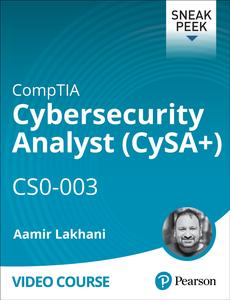
CompTIA Cybersecurity Analyst (CySA+) CS0-003
Released 11/2023
MP4 | Video: h264, 1280x720 | Audio: AAC, 44.1 KHz, 2 Ch
Genre: eLearning | Language: English | Duration: 10h 21m | Size: 2.8 GB
Table of contents
Introduction
CompTIA Cybersecurity Analyst (CySA+) CS0-003: Introduction
Module 1: Security Operations
Module Introduction
Lesson 1: Importance of System and Network Architecture Concepts in Security Operations
Learning objectives
1.1 Log ingestion–Part 1
1.2 Log ingestion–Part 2
1.3 Operating system (OS) concepts
1.4 Infrastructure concepts
1.5 Network architecture
1.6 Identity and access management
1.7 Encryption
1.8 Sensitive data protection
Lesson 2: Analyze Indicators of Potentially Malicious Activity
Learning objectives
2.1 Network-related
2.2 Host-related
2.3 Application-related
2.4 Other
Lesson 3: Tools or Techniques to Determine Malicious Activity
Learning objectives
3.1 Tools
3.2 Tools–Part 2
3.3 Common techniques
3.4 Common techniques–Part 2
3.5 Common techniques–Part 3
3.6 Programming languages/scripting
Lesson 4: Threat-Intelligence and Threat-Hunting Concepts
Learning objectives
4.1 Threat actors
4.2 Threat actors-Part 2
4.3 Collection methods and sourcesConfidence levels
4.4 Threat hunting
Lesson 5: Importance of Efficiency and Process Improvement in Security Operations
Learning objectives
5.1 Standardize processes
5.2 Streamline operations
5.3 Technology and tool integration
Module 2: Vulnerability Management
Module Introduction
Lesson 6: Implement Vulnerability Scanning Methods and Concepts
Learning objectives
6.1 Asset discovery
6.2 Special considerations
6.3 Internal versus external scanning
6.4 Agent versus agentless
6.5 Credentialed versus non-credentialed
6.6 Passive versus active
6.7 Static versus dynamic
6.8 Critical infrastructure
6.9 Critical infrastructure–Part 2
Lesson 7: Analyze Output from Vulnerability Assessment Tools
Learning objectives
7.1 Network scanning and mapping
7.2 Web application scanners
7.3 Vulnerability scanners
7.4 Debuggers
7.5 Multipurpose
7.6 Cloud infrastructure assessment
7.7 Secure coding best practices
7.8 Input validation
7.9 Output encoding
7.10 Session management
7.11 Authentication
Lesson 8: Analyze Data to Prioritize Vulnerabilities
Learning objectives
8.1 Common Vulnerability Scoring System (CVSS) interpretation
8.2 Validation
8.3 Context awareness
8.4 Exploitability/weaponization
8.5 Asset value
8.6 Zero-day
Lesson 9: Recommend Controls to Mitigate Attacks and Software Vulnerabilities
Learning objectives
9.1 Cross-site scripting
9.2 Overflow vulnerabilities
9.3 Data poisoning
9.4 Broken access control
9.5 Cryptographic failures
9.6 Injection flaws
9.7 Cross-site request forgery
9.8 Directory traversal
9.9 Insecure design
9.10 Security misconfiguration
9.11 End-of-life or outdated components
9.12 Identification and authentication failures
9.13 Server-side request forgery
9.14 Remote code execution
9.15 Privilege escalation
9.16 Local file inclusion (LFI)/remote file inclusion (RFI)
Lesson 10: Analyze Data to Prioritize Vulnerabilities
Learning objectives
10.1 Compensating controls
10.2 Control types
10.3 Patching and configuration management
10.4 Maintenance windows
10.5 Exceptions
10.6 Risk management principles
10.7 Policies, governance, and service-level objectives (SLOs)
10.8 Prioritization and escalation
10.9 Attack surface management
10.10 Secure coding best practices
10.11 Secure software development life cycle (SDLC)
10.12 Threat modeling
Module 3: Incident Response and Management
Module Introduction
Lesson 11: Concepts Related to Attack Methodology Frameworks
Learning objectives
11.1 Cyber kill chains
11.2 Diamond Model of Intrusion Analysis
11.3 MITRE ATT
11.4 MITRE ATT–Part 2
11.5 Open Source Security Testing Methodology Manual (OSS TMM)
11.6 OWASP Testing Guide
Lesson 12: Incident Response Activites
Learning objectives
12.1 Detection and analysis
12.2 Containment, eradication, and recovery
Lesson 13: Preparation and Post-incident Activity Phases of the Incident Management Life Cycle
Learning objectives
13.1 Preparation
13.2 Post-incident activity
Module 4: Reporting and Communication
Module Introduction
Lesson 14: Vulnerability Management Reporting and Communication
Learning objectives
14.1 Vulnerability management reporting
14.2 Compliance reports
14.3 Action plans
14.4 Inhibitors to remediation
14.5 Metrics and key performance indicators (KPIs)
14.6 Stakeholder identification and communication
Module 5: Certification Exam
Module Introduction
Lesson 15: Preparing for and Taking the CySA+
Learning objectives
15.1 Understanding the test
15.2 Types of test questions
15.3 Increasing your chances for passing the test
Lesson 16: Next Steps
Learning objectives
16.1 What I learned
Summary
CompTIA Cybersecurity Analyst (CySA+) CS0-003: Summary
Screenshots
Download link
rapidgator.net:
https://rapidgator.net/file/3d2949441ae12ee22640a97568d7a8e4/ezoqr.CompTIA.Cybersecurity.Analyst.CySA.CS0003.part1.rar.html
https://rapidgator.net/file/804b20b7df8dc8b2155063bbcd7654e9/ezoqr.CompTIA.Cybersecurity.Analyst.CySA.CS0003.part2.rar.html
https://rapidgator.net/file/0aafef90d07c01da96febc32fe6e69a2/ezoqr.CompTIA.Cybersecurity.Analyst.CySA.CS0003.part3.rar.html
uploadgig.com:
https://uploadgig.com/file/download/36df5177B236b5ed/ezoqr.CompTIA.Cybersecurity.Analyst.CySA.CS0003.part1.rar
https://uploadgig.com/file/download/4649fE486f718661/ezoqr.CompTIA.Cybersecurity.Analyst.CySA.CS0003.part2.rar
https://uploadgig.com/file/download/449C2938fa7aE3a4/ezoqr.CompTIA.Cybersecurity.Analyst.CySA.CS0003.part3.rar
ddownload.com:
https://ddownload.com/e9uwe41805op/ezoqr.CompTIA.Cybersecurity.Analyst.CySA.CS0003.part1.rar
https://ddownload.com/9r6xdr80xi4c/ezoqr.CompTIA.Cybersecurity.Analyst.CySA.CS0003.part2.rar
https://ddownload.com/z9o5s2ytp8bm/ezoqr.CompTIA.Cybersecurity.Analyst.CySA.CS0003.part3.rar
See full article