Setting up the Linux terminal for software development
Date: 26 February 2023 | Posted by: voska89
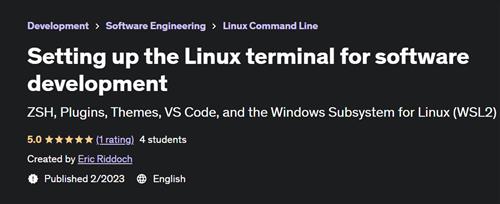
ZSH, Plugins, Themes, VS Code, and the Windows Subsystem for Linux (WSL2)
Published 2/2023
Created by Eric Riddoch
MP4 | Video: h264, 1280x720 | Audio: AAC, 44.1 KHz, 2 Ch
Genre: eLearning | Language: English | Duration: 22 Lectures ( 1h 52m ) | Size: 660 MB
Free Download Setting up the Linux terminal for software development
What you'll learn
How to set up a Linux terminal and editor (Visual Studio Code) to make your Python development workflow fast and intuitive.
How to customize the look of the terminal using ZSH themes
How to extend the functionality of the terminal using ZSH plugins
(Windows users) How to install the Windows Subsystem for Linux and integrate it with VS Code
Requirements
Basic Linux/bash knowledge: cp, mv, ls, etc. We'll install some commands together, but I won't explain the details of what homebrew or apt-get are, for example.
A computer that supports a *native* Linux terminal. If you are running on MacOS or Linux, you're good. If you are running Windows 10/11 Pro or Enterprise, we'll cover how to install the WSL 2. If you are running Windows 10/11 Home, you will need to dual boot Linux or use a different machine. (See the early Windows videos).
Description
Most software running "in production" is run on a Linux-based operating system.Deploying software onto Linux is difficult and error prone if the same software is not developed using a Linux-like environment.By the end of this course, students will have set up a Linux terminal on their own computers. They will also have customized the look and feel of the terminal to make it intuitive to use.Basic knowledge of bash commands is assumed (ls, cd, mv, rm, and mkdir).----------Important requirement:Please do not buy this course if you do not have a machine capable of running a Linux terminal.If you are running MacOS or Linux (e.g. Ubuntu), you should have no problems getting access to a Linux terminal for this course. For Windows users it's trickier. There is a free preview video about the Windows Subsystem for Linux. Watch this video to see if your version of the Windows operating system is capable of running a true Linux terminal. You will need Windows 10 or 11. If your Windows OS is not the "Professional" or "Enterprise" edition, you will not be able to take this course unless you do one of 3 things:1. Switch to a Mac or Linux machine for this course2. Buy a Windows license key to upgrade from the Home edition of Windows to Professional or Enterprise3. Dual-boot a Linux (e.g. Ubuntu) operating system on the same machine that you have Windows onYou can easily find guides for (2) and (3) online.
Who this course is for
Lower-intermediate to advanced Python developers who meet the requirements and are interested in the learning outcomes.
Data scientists, analysts, junior developers, and self-taught developers who want want to set up a development environment for writing "production-ready" software
Homepage
https://www.udemy.com/course/setting-up-the-linux-terminal-for-software-development/DOWNLOAD LINK
Links are Interchangeable - No Password - Single Extraction
See full article