Google Cloud Security Best Practices Crash Course
Date: 15 February 2023 | Posted by: mitsumi

Published 2/2023
MP4 | Video: h264, 1280x720 | Audio: AAC, 44.1 KHz
Language: English | Size: 690.13 MB | Duration: 2h 16m
Best Practices for Securing Google Cloud Resources and Data
MP4 | Video: h264, 1280x720 | Audio: AAC, 44.1 KHz
Language: English | Size: 690.13 MB | Duration: 2h 16m
Best Practices for Securing Google Cloud Resources and Data
What you'll learn
Use Identity and Access Management (IAM) to control access to resources Google Cloud
Use organization policies to control what can be done with resources in Google Cloud
Implement best practices to improve application and operations security
Apply security best practices for Compute Engine, Google Kubernetes Engine (GKE), and other Google Cloud services.
Use Data Loss Prevention service to protect sensitive and private data
Choose among Google Cloud security controls for a variety of security requirements
Requirements
Familiarity with Google Cloud or other cloud and a basic understanding of operating systems, networking, and data managment.
Description
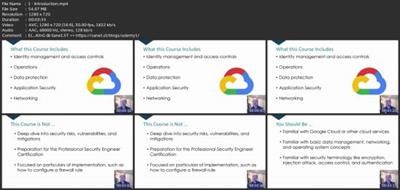
Whether you are a software developer, database administrator, DevOps engineer, data engineer, network engineer or architect, security is part of your job. This course gives you an overview of key security controls and services in Google Cloud and when to use them to protect resources and data. This course includes best practices for:Managing identities including service accounts and federated identitiesControlling access to resource using IAM rolesUsing organization policies to ensure consistent compliance with security policiesProtecting web applications against security risksUsing Apigee to protect APIsBuilding secure containersSecurely managing secrets, such as passwords, API keys, and credentialsProtecting data in Cloud Storage as well as databasesPreventing data exfiltration using. Google Cloud's Data Loss Prevention (DLP) serviceSecuring Compute Engine instances and Google Kubernetes Engine clustersUsing network security controls including Cloud NAT, Cloud Armor, Identity-Aware Proxy, and VPC Service ControlsThis course is designed for those who are new to Google Cloud or want additional exposure to recommended ways to protect data and resources in Google Cloud. The course present an overview of principles, patterns, and practices that will help you improve the security of your Google Cloud environments. This course does not delve into implementation details, such as the syntax of gcloud commands to implement a security measure on a virtual machine. Implementation details are covered in other courses, particularly the Google Cloud Associate Engineer: Get Certified course.Let's dive into learning about a variety of important best practices for protecting your Google Cloud environment.
Overview
Section 1: Introduction
Lecture 1 Introduction
Section 2: Access Controls
Lecture 2 Understand the Resource Hiearchy
Lecture 3 Understand Organization Policies
Lecture 4 Understand Identity and Access Management
Lecture 5 Federating Identities with Active Directory
Lecture 6 Managing Super Admin Accounts
Lecture 7 Securing Service Accounts
Lecture 8 Planning Accounts and Organizations
Section 3: Application Security
Lecture 9 OWASP Top 10 Security Risks to Web Applications
Lecture 10 Protecting APIs with Apigee
Lecture 11 Best Practices for Building Containers
Lecture 12 Best Practices for Managing Secrets in Google Cloud
Lecture 13 Shift Left Security
Section 4: Data Protection
Lecture 14 Cloud Storage Security
Lecture 15 Data Encryption in Google Cloud
Lecture 16 Data Loss Prevention
Lecture 17 Database Security Best Practices
Section 5: Securing Compute Engine and Google Kubernetes Engine
Lecture 18 OS Login for Compute Engine
Lecture 19 Compute Engine Security Best Practices
Lecture 20 Compute Engine Security Options
Lecture 21 Google Kubernetes Engine Security Best Practices
Lecture 22 Cloud Audit Log Best Practices
Section 6: Networking Security in Google Cloud
Lecture 23 Cloud NAT
Lecture 24 Cloud Armor
Lecture 25 Identity-Aware Proxy (IAP)
Lecture 26 VPC Service Controls
Lecture 27 Firewall Configuration Best Practices
Section 7: Conclusion
Lecture 28 Additional Resources and Next Steps
Application developers,Cloud Engineers,DevOps Engnieers,Cloud Architects,Software engineers,Project managers
Download link
rapidgator.net:
uploadgig.com:
nitroflare.com:
1dl.net:
See full article