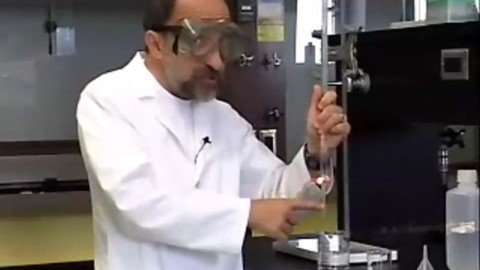
Dr. K'S Fundamentals Of Analytical Chemistry
Date: 9 February 2023 | Posted by: voska89
Published 2/2023
MP4 | Video: h264, 1280x720 | Audio: AAC, 44.1 KHz
Language: English | Size: 5.58 GB | Duration: 23h 3m
An Overview of Analytical Chemistry Topics
What you'll learn
Basic topics of Analytical Chemistry typically covered in a Quantitative Analysis University course.
Understanding the difference between qualitative analysis and quantitative analysis.
The general steps followed when performing a chemical analysis.
How units and dimensional analysis applies to calculations in Analytical Chemistry.
Solution concentrations used in Analytical Chemistry.
How to prepare a specific volume of solution to a desired concentration.
The specific lab materials for successful analytical results: Analytical Balance, Volumetric Glassware, Burets, Pipets, Filtration Devices, Desiccator and more.
The difference between random and systematic errors and how to minimize them.
The difference between accuracy and precision.
Statistics as they relate to Analytical Chemistry, i.e., Gaussian Distribution and how to test for an outlier in a set of results.
Definition and Principles of Volumetric Analysis.
Stoichiometric calculations for titrations.
How to standardize a solution by titration.
The requirements for a chemical to be a Primary Standard.
Definition and steps involved with a Gravimetric Analysis.
Stoichiometric calculations for Gravimetric Analysis.
The Conditional Solubility Product for Gravimetric Analysis.
How to calculate the mass loss of the precipitate in a Gravimetric determination.
Defining ionic strength and how it affects the solubility of slightly soluble salts.
Activity and Activity Coefficients and how they affect Gravimetric analyses.
How to form precipitates in the lab with minimal contamination and why this is important.
The difference between strong and weak acids and bases and how to calculate the pH of their solutions.
Buffer solutions.
The applications of the Henderson-Hasselbalch equation.
Calculate the pH of amphiprotic species.
How to calculate the change in pH when an acid or base is added to a buffer solution.
Buffer Capacity.
How to make a buffer solution to a specific pH.
Determining the predominant species in an acidic or basic solution.
Derivation of Fractional Composition Equations for monoprotic and polyprotic acids.
Application of Fractional Composition Equations.
Stoichiometric calculations for a chemical analysis by titration.
How to construct a titration curve for neutralization reactions.
Indicators used in acid-base titrations, the titration error and how to calculate it.
Choice of indicator for an acid-base titration.
Complexometric Titrations.
Fractional Composition Equations for the ligand EDTA.
The Conditional Formation Constant for Complexometric Titrations.
How to construct Complexometric Titration Curves.
Auxiliary Complexing Agents and how and why they may be used in a Complexometric Titration.
Chemical Analysis by Complexometric Titration.
Indicators used in Complexometric Titrations.
Back Titrations.
How to Construct Titration Curves for Redox Titrations.
Redox Titration Indicators.
Requirements of Colorimetric Analysis.
How to construct and interpret a Beer's Law Graph.
How to prepare standard solutions for colorimetric analysis.
Steps involved in a Colorimetric Determination.
Chemical analysis by Colorimetric Analysis.
Requirements
Completion of First and Second Semester General Chemistry.
A working knowledge of high school algebra including natural logarithms and exponential functions.
A desire and interest in learning about Analytical Chemistry.
Description
This course covers the fundamentals of an Analytical Chemistry course that one might take as a Chemistry major or minor. Ideally, students should have taken a year of General Chemistry as a prerequisite, as much of the material covered relies on a knowledge of equilibrium chemistry. Students in this course have access to ample supplemental material, all of which will be found in the Resource Folders. In addition to the 23 hours of lectures, downloadable audio mp3 files of each lecture are included. For many lectures, a Practice Assignment where you can test your understanding of the material can be found in the Resource Folder. Also included is an answer key for each Practice Assignment. Any graphs, figures or tables presented in the lectures are also available as downloadable files. The content of this course is as extensive as all of my other Chemistry courses are that are also available on Udemy.This course assumes that you have completed General Chemistry I and ideally General Chemistry II college courses. While you will not need to be familiar with all topics covered in those courses, you should have a good understanding of equilibrium Chemistry. As with my other intermediate courses that I have posted on Udemy, I have review sections for important chemical concepts that are needed for this course. Since this course covers the fundamentals of Analytical Chemistry, most instrumental techniques such as Atomic Absorption, UV-Visible Spectrophotometry, Infrared Spectroscopy, Chromatography and Nuclear Magnetic Resonance are not covered. Section 15 is an introduction to Instrumental Analysis where I introduce colorimetric analysis and Beer's Law, which is the basis for most Instrumental methods. Anyone who is interested in learning about various aspects of Analytical Chemistry may find this course beneficial, especially if you had no prior exposure to Analytical Chemistry in your studies.
Overview
Section 1: Introduction
Lecture 1 What is Analytical Chemistry?
Lecture 2 General Steps in a Chemical Analysis
Section 2: Chemical Measurements
Lecture 3 Review of Units and Prefixes
Lecture 4 Conversion between Units - Dimensional Analysis
Lecture 5 Solution Concentrations
Lecture 6 Converting between Molarity and mass %
Lecture 7 Preparing Solutions
Section 3: The Analytical Chemist's Toolbob
Lecture 8 The Analytical Balance
Lecture 9 Volumetric Glassware
Lecture 10 Burets
Lecture 11 Volumetric Flasks
Lecture 12 Pipets
Lecture 13 Filtration Devices
Lecture 14 The Desiccator
Section 4: Math Review
Lecture 15 Significant Figures
Lecture 16 Rounding Rules for Addition and Subtraction
Lecture 17 Rounding Rules for Multiplication and Division
Lecture 18 Types of Errors
Lecture 19 Precision and Accuracy
Section 5: Treatment of Data
Lecture 20 The Gaussian Distribution
Lecture 21 Testing for an Outlier
Section 6: Volumetric Analysis
Lecture 22 Principles of Volumetric Analysis
Lecture 23 Titration Calculations - Stoichiometry
Lecture 24 Solution Standardization
Section 7: Gravimetric Analysis
Lecture 25 Review of Equilibrium Chemistry
Lecture 26 Steps in a Gravimetric Determination
Lecture 27 Calculation Examples of Gravimetric Analysis
Lecture 28 Measuring Mass and % Loss in a Gravimetric Determination
Lecture 29 The Effect of Ionic Strength on the Solubility of Insoluble Salts
Lecture 30 Activity and Activity Coefficients
Lecture 31 Applying Activity to Gravimetric Analysis
Lecture 32 Precipitation Processes, Types and Contamination
Section 8: Review of Acids and Bases
Lecture 33 Acids and Bases Defined
Lecture 34 Relationship between[H+],[OH-] and pH
Lecture 35 Strength of Acids and Bases
Lecture 36 pH of Strong Acids and Bases
Lecture 37 pH of Weak Acids
Lecture 38 pH of Weak Bases
Section 9: Review of Buffer Solutions
Lecture 39 Buffer Solutions Defined
Lecture 40 The Henderson-Hasselbalch Equation
Lecture 41 Buffers with Polyprotic Acids
Lecture 42 Calculating the pH of Amphiprotic Species
Lecture 43 The Effect on pH of adding an Acid or Base to a Buffer
Lecture 44 Buffer Capacity
Lecture 45 Making Buffer Solutions to a Specific pH
Section 10: Fractional Composition Equations
Lecture 46 Determining the Predominant Species in a Solution
Lecture 47 Fractional Composition Equations for Monoprotic Acids
Lecture 48 Fractional Composition Equations for Polyprotic Acids
Lecture 49 Application of Fractional Composition Equations
Section 11: Titrations
Lecture 50 Chemical Analysis by Titration
Lecture 51 The Titration Curve
Section 12: Acid-Base Titrations
Lecture 52 Titration of a Strong Acid with a Strong Base
Lecture 53 Titration of a Strong Base with a Strong Acid
Lecture 54 Titration of a Weak Acid with a Strong Base
Lecture 55 Titration of a Weak Base with a Strong Acid
Lecture 56 Titration of Polyprotic Systems
Lecture 57 Titration of a Weak Acid with a Weak Base
Lecture 58 Acid-Base Indicators - The Titration Error
Lecture 59 Choice of Indicator
Section 13: Complexometric Titrations
Lecture 60 Complexometric Titrations Defined
Lecture 61 Fractional Compositional Equations for EDTA
Lecture 62 The Conditional Formation Constant
Lecture 63 Complexometric (EDTA) Titration Curves
Lecture 64 Auxiliary Complexing Agents
Lecture 65 Titrations Using Auxiliary Complexing Agents
Lecture 66 Chemical Analysis by Complexometric Titration
Lecture 67 Metal Ion Indicators
Lecture 68 Back Titrations
Section 14: Redox Titrations
Lecture 69 Review of Oxidation and Reduction
Lecture 70 The Nernst Equation
Lecture 71 The Redox Titration Curve
Lecture 72 The Redox Titration - Unequal Electron Transfer
Lecture 73 Redox Titration Indicators
Section 15: Colorimetric Analysis
Lecture 74 Colorimetric Analysis Defined
Lecture 75 Beer-Lambert Law (Beer's Law)
Lecture 76 Steps in a Colorimetric Analysis
Lecture 77 Colorimetric Analysis Example
Section 16: Appendix
Lecture 78 Analytical Balance Video
Lecture 79 Burette Video
Lecture 80 Pipette Video
Lecture 81 Filter Paper Video
Lecture 82 Filtering Process Video
Lecture 83 The Desiccator Video
Lecture 84 Drying a Sample Video
Lecture 85 Spec20 Calibration and Fe Determination
Lecture 86 Spreadsheet Tutorial
Anyone who is curious about the basics of Analytical Chemistry.,Anyone who wants to learn the basics in preparation for a full semester course at the college or university level..
Homepage
https://www.udemy.com/course/dr-ks-fundamentals-of-analytical-chemistry/DOWNLOAD LINK
Fikper
rlbzp.Dr..KS.Fundamentals.Of.Analytical.Chemistry.part1.rar.html
rlbzp.Dr..KS.Fundamentals.Of.Analytical.Chemistry.part2.rar.html
rlbzp.Dr..KS.Fundamentals.Of.Analytical.Chemistry.part3.rar.html
rlbzp.Dr..KS.Fundamentals.Of.Analytical.Chemistry.part4.rar.html
rlbzp.Dr..KS.Fundamentals.Of.Analytical.Chemistry.part5.rar.html
rlbzp.Dr..KS.Fundamentals.Of.Analytical.Chemistry.part6.rar.html
Rapidgator
rlbzp.Dr..KS.Fundamentals.Of.Analytical.Chemistry.part1.rar.html
rlbzp.Dr..KS.Fundamentals.Of.Analytical.Chemistry.part2.rar.html
rlbzp.Dr..KS.Fundamentals.Of.Analytical.Chemistry.part3.rar.html
rlbzp.Dr..KS.Fundamentals.Of.Analytical.Chemistry.part4.rar.html
rlbzp.Dr..KS.Fundamentals.Of.Analytical.Chemistry.part5.rar.html
rlbzp.Dr..KS.Fundamentals.Of.Analytical.Chemistry.part6.rar.html
Uploadgig
rlbzp.Dr..KS.Fundamentals.Of.Analytical.Chemistry.part1.rar
rlbzp.Dr..KS.Fundamentals.Of.Analytical.Chemistry.part2.rar
rlbzp.Dr..KS.Fundamentals.Of.Analytical.Chemistry.part3.rar
rlbzp.Dr..KS.Fundamentals.Of.Analytical.Chemistry.part4.rar
rlbzp.Dr..KS.Fundamentals.Of.Analytical.Chemistry.part5.rar
rlbzp.Dr..KS.Fundamentals.Of.Analytical.Chemistry.part6.rar
NitroFlare
rlbzp.Dr..KS.Fundamentals.Of.Analytical.Chemistry.part1.rar
rlbzp.Dr..KS.Fundamentals.Of.Analytical.Chemistry.part2.rar
rlbzp.Dr..KS.Fundamentals.Of.Analytical.Chemistry.part3.rar
rlbzp.Dr..KS.Fundamentals.Of.Analytical.Chemistry.part4.rar
rlbzp.Dr..KS.Fundamentals.Of.Analytical.Chemistry.part5.rar
rlbzp.Dr..KS.Fundamentals.Of.Analytical.Chemistry.part6.rar
Links are Interchangeable - No Password - Single Extraction
See full article