Updated Comprehensive Guide To Bioinformatics Databases
Date: 25 July 2022 | Posted by: voska89
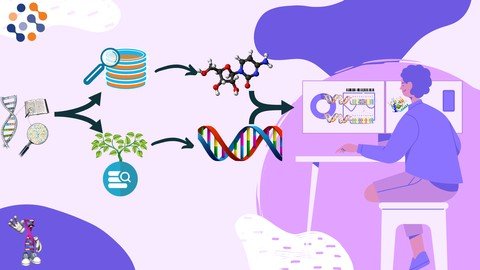
Published 7/2022
MP4 | Video: h264, 1280x720 | Audio: AAC, 44.1 KHz
Language: English | Size: 795.07 MB | Duration: 2h 19m
in and out guide to best bioinformatics databases out there being used now a days from basic to specified like genome
What you'll learn
You will gain complete understanding on Bioinformatics Databases. From basic to advance concepts.
After this practical course you will confidently choose database according to your research need without any doubts.
Different databases used in bioinformatics
They will be able to use and know different categories of sub-databases of NCBI.
Plant and Genome Databases
Primary Databases in Bioinformatics
Secondary Databases in Bioinformatics
After this course Students will have intermediate Knowledge of UCSC Genome Browser in Bioinformatics.
Students will be able to use different tools for Sequence Analysis and will know different categories of sub-databases.
Students will be able to use different tools of UCSC for Genome Analysis.
Students will be Able to perform Genome analysis on any gene
Tools Used in Plant Databases
They will be able to use and know different categories of sub-databases of Plant Databases.
Top ten databases being used in plant bioinformatics
Different Plant databases used in bioinformatics
Complete up-to Date Beginner's Guide of top Plant Databases Used in Bioinformatics along with their utilization
You will gain concrete diffrences between Primary, Seconday and Composite database. The knowledge will help you to choose curated and reviewed data.
Requirements
Basic Understanding of Biology and Bioinformatics
Basic bioinformatics terms
Willingness to learn
Description
What is bioinformatics?In biology, bioinformatics is defined as, "the use of a computer to store, retrieve, analyze or predict the composition or structure of bio-molecules". Bioinformatics is the application of computational techniques and information technology to the organization and management of biological data. Classical bioinformatics deals primarily with sequence analysis.Aims of bioinformaticsDevelopment of a database containing all biological information.Development of better tools for data designing, annotation, and mining.Design and development of drugs by using simulation software.Design and development of software tools for protein structure prediction function, annotation, and docking analysis.Creation and development of software to improve tools for analyzing sequences for their function and similarity with other sequencesBiological databasesBiological data are complex, exception-ridden, vast, and incomplete. Therefore several databases have been created and interpreted to ensure unambiguous results. A collection of biological data arranged in a computer-readable form that enhances the speed of search and retrieval and is convenient to use is called a biological database. A good database must have updated information.Importance of biological databaseA range of information like biological sequences, structures, binding sites, metabolic interactions, molecular action, functional relationships, protein families, motifs, and homologous can be retrieved by using biological databases. The main purpose of a biological database is to store and manage biological data and information in computer-readable forms.In this course, we learned about the different biological databases that are being used in bioinformatics and get to know a little bit about their details. Mainly these databases are divided into four categories and we learned about base by base. And explained the difference between the primary and secondary databases and explained their utilization in bioinformatics.This course will be extremely helpful to students of data analysts and bioinformaticians because they use the databases a lot in their work.If you guys have any questions or suggestions please let me know in the instructor's inbox I'll try to answer all of your questions within 12 hours.Genome Browser This course is mainly about the primary database browser called UCSC. The University of California Santa Cruz (UCSC) Genome Browser is a popular Web-based tool for quickly displaying a requested portion of a genome at any scale, accompanied by a series of aligned annotation "tracks." The annotations generated by the UCSC Genome Bioinformatics Group and external collaborators include genes.It is an interactive website offering access to genome sequence data from a variety of vertebrate and invertebrate species and major model organisms, integrated with a large collection of aligned annotations. The Browser is a graphical viewer optimized to support fast interactive performance and is an open-source, web-based tool suite built on top of a MySQL database for rapid visualization, examination, and querying of the data at many levels. The Genome Browser Database, browsing tools, downloadable data files, and documentation can all be found on the UCSC Genome Bioinformatics website.In this course, we will be mainly covering the utilization of the UCSC Genome Browser and performing the whole scenario on SARS-COV-2(a strain of coronavirus).And mainly learning about the Table Browser. Table Browser is also used to calculate intersections between tracks, and to retrieve DNA sequences covered by a track.All these videos will be divided into three parts containing the Introduction, Explanation, and Summary so All of you can easily understand the Course.
Overview
Section 1: Introduction
Lecture 1 Introduction of Biological Databases
Lecture 2 Types of Biological Databases
Lecture 3 Difference Between Primary and Secondary Databases
Section 2: Primary Databases
Lecture 4 Primary Databases
Lecture 5 Explaining Primary Databases
Lecture 6 Explaining Primary Databases 2nd Part
Lecture 7 Explaining Primary Databases Last Part
Lecture 8 A Survey of Bioinformatics Database and Software Usage through Mining the Litera
Section 3: Secondary Databases
Lecture 9 Introduction of Secondary Databases
Lecture 10 Explaining Secondary Databases
Lecture 11 Explaining Secondary Databases 2nd Part
Lecture 12 Explaining Secondary Databases 3rd Part
Lecture 13 Explaining Secondary Databases 4th Part
Section 4: Plant Databases Guide
Lecture 14 Plant databases introduction and tools
Lecture 15 Types of Plant Databases
Lecture 16 Brassica database
Lecture 17 Ensembl plants
Lecture 18 Genome Size in Asteraceae Database
Lecture 19 National Center for Biotechnology Information
Lecture 20 Phytozome - DOE Joint Genome Institute
Lecture 21 Plant Genome Data Base Japan. A Portal Website for plant Integration
Lecture 22 cDNA Database
Lecture 23 rDNA database
Lecture 24 PTGBase: an integrated database to study tandem duplicated genes
Lecture 25 PlantGDB Genome Browser
Section 5: Literature Databases
Lecture 26 Introduction of Literature Databases
Lecture 27 Explaining Literature Databases
Lecture 28 Summary
Section 6: File Formats Understanding
Lecture 29 Introduction of File Formats
Lecture 30 Explaining Different File Formats
Lecture 31 Summary of this Section
Section 7: Comprehensive guide to UCSC Genome Browser
Lecture 32 Introduction
Lecture 33 Searching For Genome
Lecture 34 Retrieving Corona Virus Genome
Lecture 35 Summary
Lecture 36 Introduction of Table Browser
Lecture 37 Retrieval of Whole Genome Using Table Browser
Lecture 38 importance of UCSC Browser in Corona Virus Research
Lecture 39 Summary
Lecture 40 Visualizing Corona-Virus Sars Genome
Lecture 41 Visualizing Sars Genome
Lecture 42 Summary
Data Scientist are Encouraged to take this course,Researchers are also encouraged to take this Course
Homepage
https://www.udemy.com/course/updated-comprehensive-guide-to-bioinformatics-databases/DOWNLOAD LINK

https://rapidgator.net/file/dda78aa907254bcc8a86f7904fc094eb/yneld.Updated.Comprehensive.Guide.To.Bioinformatics.Databases.rar.html

https://uploadgig.com/file/download/f6bF914017fe2beD/yneld.Updated.Comprehensive.Guide.To.Bioinformatics.Databases.rar

https://nitro.download/view/CB25E7DC2C5E2D1/yneld.Updated.Comprehensive.Guide.To.Bioinformatics.Databases.rar
Links are Interchangeable - No Password - Single Extraction
See full article